I may receive a commission if you purchase through links in this post. I am not a doctor; please consult your practitioner before changing your supplement or healthcare regimen. As an Amazon Associate I earn from qualifying purchases.
Why is most almond butter bad for you? Almond butter replaced peanut butter in many people’s pantries years ago, touted as being healthier.
Americans also love almonds themselves for snacking. Almond flour is quite common in gluten-free and grain-free baking. Almond milk replaced soy as the most popular dairy-free milk. Are we operating off of misinformation?
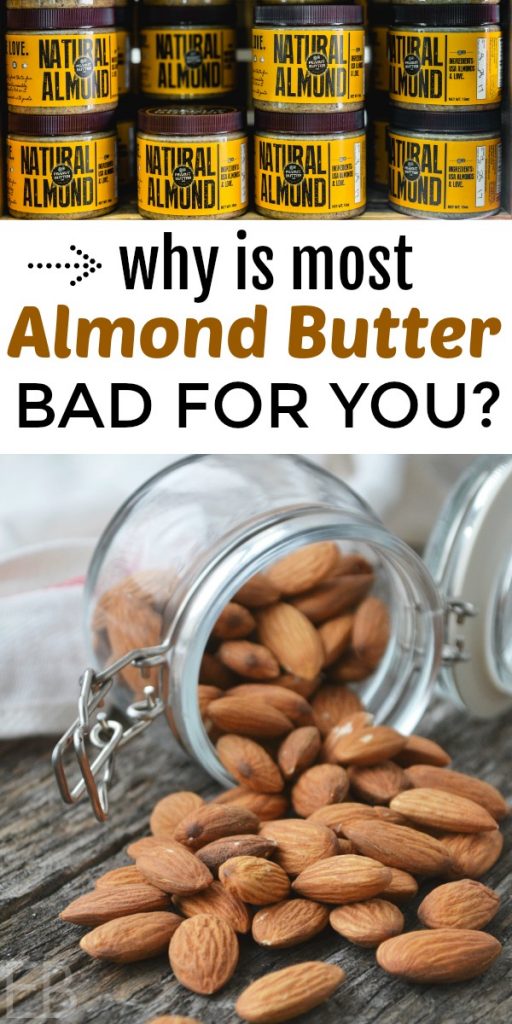
It’s not uncommon to see internet headings like, “Almonds: the World’s Healthiest Food.” These sites, when looked at, inevitably include a list with the nutritional profile of such foods: They’re full of vitamins and minerals and fiber! We are supposed to be dazzled, convinced, and most people are. However, the claims are narrow and short-sighted in their approach and understanding of nutrition.
If almonds are eaten seldomly and in moderation, after proper handling, they are nutritious. Most natural foods when handled and prepared properly are nourishing. But we have to know the whole food, its less than gentle compounds and how often to eat it amidst a balanced diet.
WHAT’S “HEALTHY”?
This article will look at almonds specifically, but also put forward ideas about how to shop for certain foods — and how and why to avoid factory-made convenience foods that are advertised as healthy. Ironically, these “healthy” foods can be as dangerous to our health as fast food from chain restaurants.
When it comes to the foods we eat, we can’t trust labels on packages to tell us what’s healthy. Words like, “healthy,” “all natural” and “gourmet” have lost their meanings after being misused.
 Sadly, even favorites like almond butter, almond meal and almond milk are not as healthy as we think.
They taste healthy; they seem healthy…
Some of you might feel threatened or sad at the thought that one of these frequently relied upon ingredients actually isn’t good for you. It takes time to digest new information that we don’t want to hear. But the good news is that my major message is one of hope: ALTERNATIVES. If we have alternatives that we love, it’s not as hard to leave behind old favorites or former comfort foods.
Almond butter, (milk and meal) can be temporary or occasional ingredients.
Let’s delve in and be very specific about the problems with almond products. There are five main issues that can make them a disease and cancer-causing convenience food.
1. Heavy metals
Recently updated in 2026, this article now includes information about the heavy metals found in nuts — a fact little discussed until now.
With Parkinson’s on the rise, it’s hard to ignore the heavy metal manganese, now completely linked to Parkinson’s and found in nuts, seeds and peanuts. While peanuts are considered high in manganese, almonds (and almond butter) have twice the amount of manganese as peanuts.
Similarly, almonds deliver high amounts of copper and nickel — metals increasingly linked to a wide range of health conditions. Excess intake of these metals can disrupt hormones, including thyroid function, and contribute to anxiety, depression, EMF sensitivity, joint pain, sleep problems and other serious symptoms.
This fact alone tells us one thing: Nuts, seeds and peanuts should not be eaten daily for healthy living and longevity. These foods should only be occasional in our diets.
2. Oxalates
Almonds are considered one of the most concentrated sources of oxalates, which can contribute to the formation of calcium oxalate kidney stones.
Individuals prone to calcium oxalate kidney stones are typically advised to limit or avoid almonds.
This compound accumulates over time in people with liver or gastrointestinal issues, then manifests in subtle, hard-to-trace symptoms that obscure it as the underlying cause.
3. PUFAs
Almonds’ omega-6 to omega-3 ratio is heavy on the omega-6 side. The typical American diet is already heavy in omega-6 fatty acids, which is why so many doctors now recommend foods and supplementary fish oils high in omega-3s, to get the balance back to where it should be.
(However, fish oil is also not healthy.)
The ideal ratio of these necessary fats in our diet should be anywhere from 1:1 to possibly 4:1. Many Americans today eat a diet that is 30:1, heavy on the omega-6 side.
Where is the imbalance coming from? Grain-fed meat and lots and lots of polyunsaturated oils that in some cases we are still being told are good for us (oftentimes found in processed foods and most restaurant food): grapeseed, sunflower, safflower, corn, peanut, soybean, margarine and hydrogenated or partially hydrogenated oils, as well as canola oil. (If you are still cooking with these oils, please stop and replace them with natural fats: grass-fed butter or ghee, olive oil, coconut oil, avocado oil or fat rendered from sustainably-sourced meat.)
Start with a typical American diet, then layer on the advice that “almonds are healthy,” and you end up compounding fat imbalances and adding another digestive burden.
However, if our diet is remedied to a more balanced, anti-inflammatory and natural diet, and then we enjoy a handful of almonds a couple of times a week, or use them sparingly in baking, we are in good shape!
What to eat instead
I think the main message here is actually really simple and just takes a little practice and some recipes: Stop eating factory made food and regular restaurant food. This includes rotisserie chickens from Costco and grocery stores.
The foundation of restored health is simple: fresh or carefully raised ingredients, low in toxins — prepared with homemade techniques and know-how.
Look for local companies you can support that are doing this.
Here’s a shocking exercise: Look at the ingredients in your local health food market’s salads and soups. You will surely find polyunsaturated oils. Even natural markets do not have the knowledge to avoid these oils; or their profit margin issue makes it difficult to stick to olive oil and other safe choices.
When buying any nut or seed, buy from sources with a quick turnover.
4. Pasteurized almonds
In 2007 legislation passed in the United States that required the pasteurization of almonds, due to two Salmonella outbreaks from California-grown almonds. Pasteurization uses one of two methods: heating the almonds to temperatures of 200 degrees or higher or the use of propylene oxide gas, a “probable” carcinogen, as noted by the United States Environmental Protection Agency. Most conventional almonds are undergoing this gassing process; and no U.S. commercially grown almonds are raw.
Update: In 2015 a chemical-free process for pasteurizing almonds using radio frequencies was approved! This is great news, as it’s a natural alternatives for killing pests and molds. It is not used pervasively at this time, but at least it’s an approved alternative to the more prevalent carcinogenic gases. (source)
The U.S. government took the same approach with the pasteurization of almonds and these Salmonella outbreaks as it took with the pasteurization of milk. The conventional farming practices that contributed to the Salmonella outbreak in California were not addressed on a nation-wide scale.
Heating and killing, or poisoning, are easier than addressing the side effects of conventional farming techniques. (Sustainably raised crops practice biodiversity wherein grasses and weeds actually help to prevent salmonella.) The newer mono-crop farming method of raising literally 70,000 pounds of one food per season is a risky sponge for infection (and reduces nutrition in the farmed food over time as soils are depleted).
As an informative article from cornucopia.org points out,
“This may be the first step in a slippery slope toward a sterile food environment that protects processors from lawsuits and facilitates industrial-scale food processing and distribution—which is exactly the kind of environment that facilitates bacterial contamination, but does not necessarily protect consumers from illness, while offering few food choices to consumers who prefer raw and unprocessed foods.”
Let’s learn our lesson. We don’t need to eat poisoned and pasteurized almonds for decades. Look at the history of milk, with many of us now drinking dairy-free milks or making sure our sources are grass-fed, raw, full of probiotics, and/or locally sourced.
Instead, we need to seek out whole, fresh, untreated foods.
Good almond butter option
If you’re going to buy almond butter, look for sustainably grown almond companies. This is one good option because it’s made from fresh organic almonds, and it’s packed in glass jars instead of plastic.
5. Rancidity in almond butter
That leads to the final reason to avoid most commercially made almond butter, almond meal, almond flour and blanched almond flour. All nuts have a short shelf life. They are prone toward rancidity.
Most big companies are not mindful of this truth.
Rather, they look to mass production, a competitive selling price and the effectiveness of a good label to make their product look healthy and desirable.
Who makes sure the almonds are made into butter quickly after harvest and/or frozen to prevent further aging of the nuts’ oils?
What’s wrong with a rancid nut? Until you’ve eaten only fresh nuts you won’t necessary taste the difference.
But rancidity in food is not something to ignore.
Paul Pitchford of Healing with Whole Foods: Asian Traditions and Modern Nutrition writes that possible complications from eating rancid nuts include,
“… irritation to the linings of the stomach and intestines; the oils in them cannot be digested or assimilated efficiently; poor immunity, cancer and other chronic diseases; destruction of vitamins … in the food plus those stored in the body; gall bladder and liver complaints.”
And Andrew Weil, integrative medical specialist, says of the rancid oils found in nuts, “They’re carcinogenic, pro-inflammatory and very toxic.”[1]
[1] The Dallas Morning News, April 2012

Anne Summers says
Thanks so much for this education, Megan! Being a major enthusiast of good almond butter, I appreciate knowing how to prepare/buy it for maximum health.
meganseanastevens says
Thank you, Anne! 🙂
Sandi Bellack says
I’m not interested in making my own.j I’d rather purchase sprouted nut butters…
Raia Torn says
Excellent article, Megan! Thanks so much for putting it together so clearly and concisely, without bashing anyone who is addicted to almonds. 😉
Megan Stevens says
🙂
Danny says
Man you people worry too much about what you eat lol just get a jar of nut butter and don’t f***n worry about it just get organic and eat it.
Just do the best you can and go on.
( we all gonna die someday geesh )
Megan says
Hi Danny, while your comment made me smile and I can appreciate your perspective, many of us have spent years fighting for our health and working hard to feel “normal” again. So, something like rancid food or too many omega 6s and inflammation is actually nice to learn about and helpful, not worrying. We make a change, and see improvement. Also, most Americans don’t ever think about how we destroy our resources, like use way too much plastic or water in desert agriculture. So again, this is great to write and read about, because it’s our responsibility and can be a joy to do better.
Omar Michael Ayyash says
I’m still battling it myself too. Just don’t have the resources to do a lot of what you said. I am going to a local farmer that’s has organic produce and honey and eggs, but I still feel stress. Maybe it’s just the environment. I can’t get raw milk, but the best I can do is low-heat pasteurized, but I can get local, and local cheese that’s also organic and low-heat pasteurized… I would like to get local fresh organic nuts and seeds, but that is not possible for me.
Megan says
I hear you, Omar. The people who live longest seem to be the ones who enjoy/savor their meals, have community and less stress. So we can only do what what we can, and then take a deep breath and enjoy all the blessings with a thankful calm heart.
Loretta says
Is making almond milk a healthful choice after 12 to 16 hours of soaking in salted water?
Megan Stevens says
Yes, you just want to rinse the almonds well after they’ve soaked and allow this to be a special drink that is not a staple that you consume every day. If you consumed the milk every day it would be too many Omega-6’s in your diet. 🙂
Jennifer Galvin says
Do you recommend a home made hemp milk or another nut milk over almond milk? I love making homemade almond milk. But I’m open to changing to have more omega 3’s, or a better option.
Megan says
Good questions, Jennifer. It also depends on the rest of your diet and your sourcing for the almonds. For example, if you’re eating a lot of grass-finished beef, then you’re getting a good source of omega-3s. If you’re doing almonds in moderation with the beef, that could be okay. But if you’re doing just a little omega 3s in your diet and a lot of almonds, I’d work to change that ratio. Sourcing-wise, if you’re buying California almonds, I’d look to change to Spanish sourcing or another habitat that they’re native to where they’re grown organically. Other options instead of almonds: the best nuts for us are actually macadamia, although they’re important to buy organic, and I know they’re expensive! (Here’s that recipe if it’s helpful: https://eatbeautiful.net/keto-paleo-macadamia-nut-milk-homemade/ Hemp is higher in polyunsaturated fats than is ideal. Other good nuts and seeds to consider include Brazil nuts and pumpkin seeds. One other thought: Have you tried how oat milk does with your body? I was grain-free for over 10 years and never thought I’d return to grains, but have ended up phasing oats back in and found them to be helpful and gentle. So that’s the milk I now drink most often. Hopefully one of those 4 options will be helpful!
Trisha Schmidt says
Hello and thank you for all the information
My daughter and I drink almond milk, organic, but now I’m concerned about heavy metals
Do you recommend A1 organic grass fed cows milk in front of almond milk?
Also, you mentioned oat milk
Is there an organic glyphosate free brand you recommend or do you make your own
Megan says
Hi Trisha, I’m sorry for the late reply! The best option of all would be to get a milk maker that makes both rice milk and oat milk. I have the Almond Cow brand and make both rice and oat milk with it weekly. Yes, clean oat milk brands include Malk, Three Trees and Forager. I don’t recommend A2 or A1 milk. Good for you to reconsider regular almond milk consumption. Milk from white rice will be the most toxin-free, as far as all toxic metals. Even oats have nickel.
nis says
Thank you for this detailed explanation! We tend to consume nuts from costco and my guess is those aren’t raw, right? Would you know of any bulk stores in Portland Oregon where I could purchase raw nuts at a reasonable price. Thanks!
Megan Stevens says
We have a company here in Eugene called Hummingbird Wholesale that ships; or you could come down on a Thursday when they are open to the public. They have the freshest nuts anywhere, a huge turnover, high demand. Re Costco, they do sell some raw nuts and their turnover may be good; it’s just hard to know how long they may sit in a field or warehouse before they’re sold. If freshness is a question the vitamin C in your soaking water can help avoid the dangers of rancidity. I don’t know about PDX; but Humm. Wh. is the best anywhere, so might be worth the trip or the shipping rate. Cheers!! 🙂
nis says
Thanks Megan….looks like shipping may be my best option right now.
kate says
but are the almonds from Hummingbird truly raw? i thought that one could not get raw almonds in this country…i think that you mentioned that …..i’m confused.
Megan says
Hi Kate, you can order almonds, through various wholesalers, from places like Spain, that are truly raw. Companies like Hummingbird buy from all over the world.
Anj says
I don’t think the Costco nuts are truly raw. That term is often used to denote UNroasted (raw) vs. roasted nuts, but my understanding is (due to the law) they’re still flash pasteurized.
Megan says
I agree on any almond coming out of California especially.
Anj says
“Raw” nuts at the store are NOT truly raw. They’re actually still flash (or regularly) pasteurized. That “raw” label simply means UNroasted.
linda spiker says
Fabulous information! I now have my dehydrator and am going to be a dehydrating machine, lol.
Megan Stevens says
Yay!!! What fun you’re going to have and you will love the texture and flavor so much too. They really snap in your mouth when they’re sprouted! 🙂
Sarah says
I read the article but I’m not clear what your opinion would be on the type of almond butter that I’ve been using. I buy organic almond butter that is freshly ground when I press the button on the grinder. Is there a chance these organic almonds are not raw? Or are you worried about the turnover since it’s an expensive item?
Megan Stevens says
Thanks for your question, Sarah. That almond butter is not a good choice for a few reasons. The almonds in those machines are not fresh, very likely rancid and may even have mold (that you can’t see). If not organic, then they contain glyphosate residue, which poisons and slows detox.
Donald Godown says
Everything you have informed me of is very easy for me to believe about our FDA. I’m a new learner to alot of health issues, and the bigest problem for me is where to purchase organic, sprouted, dehydrated Almonds.
Lindsay Fraser says
Great article. How long do you feel that homemade sprouted nut butters are good when stored in the refrigerator? Even if they are still good, do they loose their nutritional value quickly? Is it different for each kind of nut? Thanks!
Megan Stevens says
Hi Lindsay, thank you. I’m not sure actually. My guess is 6 months. And yes, walnuts degrade the fastest. Beyond that we’d need to look up…yes, it’s different based on the nut or seed’s fat profile. Blessings!
Judy says
I see this is an old post, but I am hoping you can share your thoughts… Do you think there are health issues with drinking a few cups of nut milk every day if made properly with fresh, soaked nuts or seeds, and rotating the kind of nut / seed used? I like to rotate between almonds, walnuts, cashews, pumpkin seeds, and sunflower seeds. Due to some health issues, I am currently on a liquid diet, consisting of fresh vegetable juices, homemade bone broth, and nut milks. The milk really helps me feel full. I have been unable to find any good information about health issues with homemade nut milks- most articles refer to commercially made milks. Any insight will be appreciated!
Megan Stevens says
Hi Judy, happy to help. Sorry for the delay in responding; we just returned from a trip. Based on my own experience, I believe there are seasons in life when we make certain nutritional choices to get us through a time and to reach a certain goal in healing. For you this may look like lots of soaked nut and seed milks, because you have so little else. You need those carbs and that protein. I say, YES. 🙂 But on a broader diet, I think it’s too much of the same thing and may still cause a food sensitivity or be too many anti-nutrients/heavy metals etc, even properly soaked. So I’d give yourself that freedom now, and enjoy, but just listen and watch for symptoms, so you can back off as soon as you’re able. Eventually you could have less because you’ll have other options in your diet. Blessings!!
Jessica says
Hi! I just read this article. Would you put coconut milk in the same category, or is this safer to drink? I use coconut milk and cream as a staple in my shakes and cooking.
Megan Stevens says
Coconut milk is healthful, but it is a source of high copper. It’s a good food to enjoy in moderation. I’d be cautious of factory-made coconut milks that have additives. I do buy/make 1-ingredient coconut milk occasionally, for certain recipes, but it’s not a staple.
Food4life says
This was one of the worst articles I have ever read. It took way to long to make a point and I’m not sure if there is a clear point of the article other than to sell a book. Starting with the conclusions for such an overly complex article may have been a good idea. Food for thought for future articles.
Adriana Wollmann says
Very nice article Megan!
Wich milk do you think we can drink every day?
Is home made the olny option?
Thanks
Megan Stevens says
Hi Adriana, good question. I personally drink homemade rice, oat and macadamia nut milks the most often. It depends on one’s health, though, and health goals. Homemade banana milk is a little weird, but it’s a great option if it’s appealing. For store bought options, a clean oat milk is good, with just a few ingredients (no vitamins or oils added).
Adriana Wollmann says
Very helpful!
Thank you very much.?
geo2209 says
What about almonds like Wild Soil that are steam pasteurized and (I think) sproutable? They also claim their standards are above organic as well. The flavor on them compared to the PPO pasteurized is amazing.
julia says
I too just bought Wild Soil. Have you found anything else out about them? I too think their flavor is amazing.
Megan says
Hi Julia, great question. Their attention to freshness, quality and good growing conditions are encouraging. I think they’re a much better option than most brands! But they’re still almonds grown in California = sad use of water. I’d love to see crops in CA that are native to the desert it is or at least with lower water needs.
Getting Real in Your Kitchen says
Really great information. I am just wondering how long raw, sprouted almond butter lasts before there is a risk of it going rancid.
mike says
when is nutrition going to become science, and evidence-based science , instead of ever changing personal opinions?
JW Kirby says
I have long suspected most nuts in general, and almond butter on particular, is rancid! My nose is pretty keen! There’s a certain dude selling all kinds of almond butter nationally, which have been awful on my several experiences. Anyway, thanks for bringing this to forefront.
William Colburn says
Watch out for SEA SALT…the fda does not regulate this product and it may contain umami ingredients like MSG which are not necessarily on the label.
Pinkgem says
Just to let you know halfway through reading this article, an ad for McDonald’s popped up. I don’t know if this is something you have control over, but it’s not the sort of ad you want on your site! Great if on almonds btw, I don’t use them a great deal but I wasn’t aware of the pasteurization thing.
Megan says
Hi, thanks for letting me know! Ads are usually based on a reader’s viewing history. But I appreciate knowing because I do have some control. 🙂
Deborah says
Thank you for the pillars of selecting good almond butter! I always thought they were healthy in moderation, but never knew we should not buy them pasteurized! I’ll be smarter next time I spend our hard earned money on almonds (especially from bins) or almond butter! Great article as always, Megan! Also, so we want more omega 3’s than 6’s, right? But, what is the proper ratio?
Megan says
Hi Deborah, you’re welcome, and thanks for your comment. 🙂 One way of looking at omega-6s that’s helpful is that they cause inflammation. In contrast, omega 3s are needed by the body, but we can only get them from food; our bodies do not produce omega-3s. Chris Kresser explains that, “the more omega-3 fat you eat, the less omega-6 will be available to the tissues to produce inflammation. Omega-6 is pro-inflammatory, while omega-3 is neutral. A diet with a lot of omega-6 and not much omega-3 will increase inflammation. A diet of a lot of omega-3 and not much omega-6 will reduce inflammation.” Kresser suggests that a 1:1 ratio is ideal and similar to what our ancestors ate. What others have mentioned that is even more important is the quality of fats we eat. We really don’t need to count if we’re being aware of balance, careful to avoid rancid fats and factory-raised meat fats meanwhile seeking out fresh foods (with bioavailable nutrients) that are raised with care.
mark nicholson says
love the article and great info to know.. I have dealt with gut issues for past 3 years and something i just caught in the article says almond milk is not good and every single day i use it in my protein shake in morning with greens and avacado.. I guess ill use water and was wondering why my shake bloats me somedays… Is there a great website or book or resourse for the proper food so i can get past all these
hidden chemicals in the food so i can beat this candida,ibs,leaky gut etc etc.. I eat very healthy but still not healing and im sure a lot of my organic diet there is something hidden thats hurting me…
also i just ordered your pumpkin nut butter
whisperingsage says
If you can get the lard from homegrown local farmers, it is not hydrogenated and should be safe. In my case, I would be raising those animals . Currently, most of my tallow comes from my goats and sheep, who have a nice packing of fat to get them through the winter. I guess it’s only humans that are unhealthy when fat.
Chauncey Raiford says
Thank you so much for sharing this information. This was my confirmation.
A.D. says
So, are nuts labeled as “raw” not actually raw, then?
And if they’ve already been pasteurized or roasted, what problems does that pose? Thank you.
Megan says
Hi there, it depends on the nuts. For example, cashews are not raw, even when labeled raw. Almonds are not raw, even when labeled raw, unless imported from a country that does not require pasteurization or purchased from a small local farmer who can account for their history. Pasteurized and roasted nuts can no longer be sprouted or activated, so this makes them higher in phytic acid and harder to digest (harder to access their nutrients, rougher on the GI tract and stomach). A roasted nut still has reduced phytic acid, but not as much as if it was activated first and then dehydrated. Many people will wear down their digestive mechanisms over time by eating nuts that aren’t sprouted.
A.D. says
Thank you!
kate says
As far as ‘raw’ cashews, Divine Organics are supposedly really raw. They do a cold process with their cashews.
People may want to go to their site, and ask some questions. They are the only cashews i use, but who knows if they are truly raw. The bottom line is that companies want to sell their products. $$$$$….
kate says
Thank you for your reply. Our coop now has almonds from Italy that are not pasteurized…..they used to carry unpasteurized almonds from Sicily, but i noticed that the almonds they have now are Italian. I did some research a while back, and the almonds coming into the US are steamed ( i guess it’s not quite like pasteurization) . I think it’s a bit difficult to get the solid truth about almonds. I was buying truly raw almonds ( $12 lb.) from a gal in town several years ago, that was getting them directly from some almond farm in California, and i think they were really raw. The way to tell if an almond is raw is to soak it, and if the skin refuses to peel off ( pop off) easily, they are raw. Steaming or pasteurizing causes the skins to come off easily after being soaked, as it’s really similar to blanching. The almonds from both Sicily and now the ones from Italy occasionally have a VERY bitter almond in the batch. They are horrible….and sure taste like they contain cyanide. ugh.
I think i may just give up on the almonds and make milk from coconuts…..i think that’s the safer way to go. Thank you. kate
Megan says
That sounds like a good conclusion. Coconuts are a sustainable crop. 🙂
Sandi Bellack says
Not interested in making my own. Not everyone has the time to wants to do it themselves. I buy sprouted nut butters. I’m just hoping not being pasteurized is okay and safe.
Joel Godin says
Thanks Megan on your research.
Here’s my story. I was eating lots of almond butter from TJ and
soon I was getting headaches every day. I felt fluid was collecting in my head when I slept and
had to raise the pillow to keep my head high or I felt my head would explode.
Long story short, I found 3 things would bring on a headache, honey, chocolate, and almond butter.
I cut these three out and my headaches stopped on a dime. No more fluid to the head feeling.
And I thought I was eating healthy, lol.
Megan says
Hi Joel, thanks for sharing! It’s true, there are so many “super foods” that are actually not healthy for us to consume regularly. Sometimes we find this out because we start eating them all the time, instead of barely ever, and symptoms come on. I’m glad you figured it out.
TM says
Thanks!
Questions:
1. what is the source of the vitamin c crystals? Not abscorbic acid, is it?!
2. which Brand/Model is a good dehyrator, please? With no plastic parts, I would think; and long-lasting? Any recommendations?
3. A good water purifier? Any recommendations? (Purification differs from filtering and reverse osmosis, yes/no?
Thanks!
Liz says
When sprouting almonds does it change the omega 6vs 3 ratio or is it not effected? If it does change it, do you know what it is?
Megan says
Hi Liz, great question. Actually, sprouting reduces the overall fats in nuts or seeds, while it boosts the protein content and vitamin and mineral bioavailability. The omega 6s do reduce. (Specifically, sprouting boosts the bioavailability of the minerals: phosphorus, calcium, iron and magnesium tied up in phytates, and increases levels of amino acids and protein [Vitamins B2, B5 and B6] by 50% while decreasing fats and carbs by up to 25%.)
Ellen Hodges says
That was a wealth of information Thanks for taking time out to research such valuable information an enlightened us l will now cut back on process Foods they are not Healthy for the body they are only quick fix. Into the long run we slow down and age quickly whenever feed our self on them Thanks again
Megan says
You’re welcome, Ellen. Thank you for your kind comments, and I’m so glad the article is helpful!
Ellen Hodges says
I had my comment written my email not going through to you
Megan says
Hi Ellen, I got your other Comment and just responded, so all is well. 🙂
Angela says
Hi Megan
I only found your site today and I’m glad I did.
I have been drinking Almond Milk every day for months. The milk I have been buying is better than most. It is called Inside-Out unsweetened Almond Milk with only 4 ingredients. (this is from Sydney, Australia). The ingredients state:
Almond Milk (99%), Filtered Water, Activated Almonds (9%), Sea Salt, Vegetable Gum (Gellan)
I don’t understand how the Activated Almonds are only 9%. and the Vegetable Gum isn’t good.
My main concern is the Omega 6 content. Also I have been itching all over a lot so I may have an allergy.
I’m sorry for such a long comment. I’m very interested in you cookbook
Megan says
Hi Angela, yes, the omega 6 content is a great thing to be aware of, and great to try and get to the bottom of the itching. Finding the right milk can be so hard. If at some point you’re eating grains, you might also look at Malk’s Oat Milk, which is the cleanest, best non-dairy milk I’ve found.
Fs says
Thank you for this article and information! Will take it into consideration. If I had to buy almond butter, I don’t eat it often, would it be ok from Whole Foods dry roasted almonds as the only ingredient be ok?
Megan says
Hi Fs, honestly, this is not one I would buy or eat, sorry to say. I would look for the companies that offer an organic almond butter. Two that come to mind are by Wilderness Poets and Artisana. Ideally, not from CA almonds (unless it’s a company working with low water growing methods, which is beginning to happen; there are some transitional farms doing this), but I understand that it’s hard to check all the boxes.
Fs says
Thank you =) I’ll see if I can find those brands. Or maybe do cashew butter, maybe that is better.
Megan says
Great. Cashews often have mold; sorry to be a downer, and some other issues. The best in my opinion is homemade macadamia nut butter. Happy to help, and best!
brandon alexander says
But who ever brainwashed us into thinking that store-bought, factory-made almond butter was health food?
Nonsensical
I didn’t need to read past that.
Yes, exactly, store bought food is unhealthy and should be avoided at all cost.
Of course, why have I never thought of this before. Yes, that sure does make a lot of sense
Okalee Dokalee
Val says
This was such a great and insightful article, I’m so glad I stumbled upon it. Thank you for all the valuable advice. I am now looking at finding a good sprouted nut butter that I can purchase in the UK – not sure I will always be able to make our own. But my 4 boys do love the occasional nut butter on toast and we use it to make frozen treats with bananas.
What are your thoughts on home made soya milk? We make this daily and since we are vegan it tends to work well as a milk substitute, Curious about your opinion.
Thanks again!
Megan says
Hi Val, I’m happy the article was helpful, and glad to comment on homemade soya milk. My concern with soy milk is that it’s estrogenic, and in this modern world, we are already now bombarded with estrogens (xeno and phyto). I think better options include oat milk (my favorite choice), Bean Milk (less delicious for teens, but still good) and Macadamia Nut Milk (awesome, but expensive, and it’s important to get nuts that are organic and not rancid). Since you’re used to soya milk, the bean milk might work for you all, or you could try an Oat-Bean combo. Such good nutrition from the three options I mentioned. Organic oats are also affordable. (Here are two of the recipes if it’s helpful: https://eatbeautiful.net/keto-paleo-macadamia-nut-milk-homemade/ and https://eatbeautiful.net/vegan-bean-milk/)
MARY RYAN says
great article. I went off grains and started soaking, sprouting, dehydrating. As always, I enjoyed the “paleo” granola a little too much and had too many seeds/nuts. Started eating savory breakfasts with more protein and eat nuts less ocasionally.
Nuts are very $$$ and with the economy most people could not afford to buy let alone soak, and sprout with limited time and working multiple jobs.
An article geared towards simple, healthy cooking with be more applicable to those types of people who are often the ones with the most health problems.
Another note, our society is food obsessed. We live to eat, not eat to live. Pinterest if full of recipes with chocolate in everything calling it healthy. We need to get back to basic eating with healthy fats to fill us up. Eat desserts as a treat, not an everyday meal.
Easier said than done. I think it’s a whole mindshift that needs to happen. It may happen earlier than later if we go to war and food is scarce. People will be forced to grow their own food and their favorite foods may not be available!
Bottom line: do the best you can with the resources you have. Enjoy it and be grateful!
Megan says
Thanks for sharing, Mary! 🙂
Jac Brown says
First if all, I wish the Internet could answer a question without having us read pages of almond butter history. I don’t have that kind of time. Now, having skimmed through the article, I’d just like to say that after trying to like almond butter several, I still think it’s horrible, too thick, stiff, globby, and flavorless. I barely manage to not choke on it. But I almond milk has been healthy for me for several years now.
Shelly says
What if you have a child with severe peanut allergy and cannot have eggs? Parts of the Price diet won’t work. Almond butter is currently the main “nut butter” my kid can have. I don’t use sunflower butter bc there are environmental concerns with sunflowers now. He needs the fats and a little protein at snack time.
I’m feeling very upset bc now you’re saying almonds are a no but we can’t do peanuts, and there are only so many fats I can provide that aren’t unhealthy or without overdoing the protein.
Megan says
Hi Shelly, life is tricky; I understand. Really, the whole way we use nuts in our diets is not ideal. It should be a small amount occasionally. Would you consider more beans in your diet, for example? They’re so similar to nuts, but much healthier, a true staple. You might consider making a “nut” spread from beans. There are recipes that use part almond butter, so that would allow you to use less, and there are recipes with only beans and the other ingredients, no nuts or seeds, but they’re used like peanut butter, and they’re delicious. I think that’s an exciting long term solution. Here’s a recipe that I hope you end up loving:
1 3/4 cup cooked white beans (or one 15-ounce can white beans, drained and rinsed well)
1/2 cup natural almond butter
2 T. honey
1/4 to 1/3 cup milk of choice
Combine in food processor, and blend until smooth. Store sealed in fridge maybe 1 week? Freeze if smaller portions are needed. Needs to be chilled for best texture. Blessings!