I may receive a commission if you purchase through links in this post. I am not a doctor; please consult your practitioner before changing your supplement or healthcare regimen. As an Amazon Associate I earn from qualifying purchases.
Many people are deficient in potassium and yet don’t know that their symptoms and lifestyle are indicators. For example, stress depletes potassium, and most people can’t avoid stress. The deficiency of some minerals also causes a potassium deficiency, as does the excess of certain toxins.
Getting enough potassium is important for overall health, but it’s hard to test for; so symptoms are the most important indicator of deficiency. (Blood potassium may look fine, or even high, with lab testing, when there is actually an intracellular potassium deficiency.)
Potassium relieves many symptoms, including insomnia, GI related, heart and blood pressure, cramps and fatigue. Consider supplementing with this essential mineral, and see if it makes a difference.
This post shares, in part, my story with potassium and insomnia — as well as some how-to tips about which kinds of potassium to try.
Side benefits — If you’re experiencing even one symptom of potassium deficiency, increasing potassium may help improve more than just that single issue. Many people find that when they correct a potassium deficiency, several other symptoms improve as well. We’ll discuss these below.
Potassium deficiency symptoms
As you may know, bananas are a great source of potassium and a really quick way of telling if more potassium will help your body. Does eating two to three bananas make you feel better? You may need more potassium!
One of the best indicators whether or not potassium will help your symptoms is: if you have potassium deficiency symptoms:
- Leg, toe or foot cramps, especially at night — I had these during my pregnancies, but they came back when I started increasing my magnesium! Surprising, but this was my body’s way of telling me that I needed more potassium! If magnesium gives you a racing heart, this also indicates a potassium deficiency. Why? More magnesium enhances the imbalance that is already present and makes it apparent. (Reacting to Epsom salt baths also indicates a potassium deficiency.)
- Heart arrhythmia and/or palpitations — I had both of these, not all the time (for the palpitations), but they were both issues. These will commonly go away once potassium supplementation is established, especially when combined with a tailored anti-inflammatory diet.
- Feeling tired after a meal — Potassium deficiency causes tiredness after a meal primarily because low potassium impairs insulin secretion, leading to poor glucose uptake by cells, which prevents nutrients from being converted into energy effectively. This results in muscle weakness, fatigue and sluggishness, rather than post-meal energy. (Feeling tired after a meal can also be a reaction to gluten [but isn’t for most]).
- Excessive thirst — I had this symptoms for many years without knowing the cause. This occurs because low potassium levels impair the kidneys’ ability to balance electrolytes, leading to increased fluid loss in urine, which triggers thirst to compensate.
- Digestive problems — Potassium deficiency may contribute to digestive problems. Potassium helps the digestive tract muscles contract and move food properly, so when levels are too low, digestion can slow down — potentially leading to additional symptoms like bloating and constipation.
- Additional — Tingling, numbness, excessive urination, high blood pressure (but I have always had low blood pressure, so not all symptoms need apply. I had most of the rest of these, at least intermittently.)
Vaguer symptoms:
- Anxiety or Depression, struggles with mental health
- General fatigue
- Constipation
- Headaches
- PMS symptoms, including cramps and mood issues (See below about supplementing with both potassium and magnesium to address PMS symptoms. If this is a chronic issue for you, also see this zeolite article and this MSG article.)
- Neck pain
What can cause potassium deficiency
Also called hypokalemia, potassium deficiency can result from:
- stress
- alkaline-causing supplements, or a diet high in produce (lots of vegetables and fruits)
- low sodium diet
- low magnesium (Some people are unable to maintain healthy potassium levels because they’re too low in magnesium, a mineral needed to help transport potassium into cells. Be sure you’re also supplementing with magnesium.)
- vitamin A toxicity (blocks potassium channels and is now being recognized as a more common toxicity than formerly thought)
- copper toxicity (depletes potassium; also now being recognized as a more common toxicity than formerly thought)
- stored vitamin D in your tissues from supplementing (depletes potassium)
- intense exercise, extreme sweating
- shock (After my mom passed away, and I was the one who found her in a coma, I was potassium deficient for two months. I kept coconut water by my bedside each day, which was in addition to potassium supplementation.)
- chronic diarrhea or vomiting
- kidney problems
- diuretics or laxatives
- insulin
- corticosteroids
- eating disorder, undereating
- regular alcohol consumption
- prior surgeries
- endocrine disorders
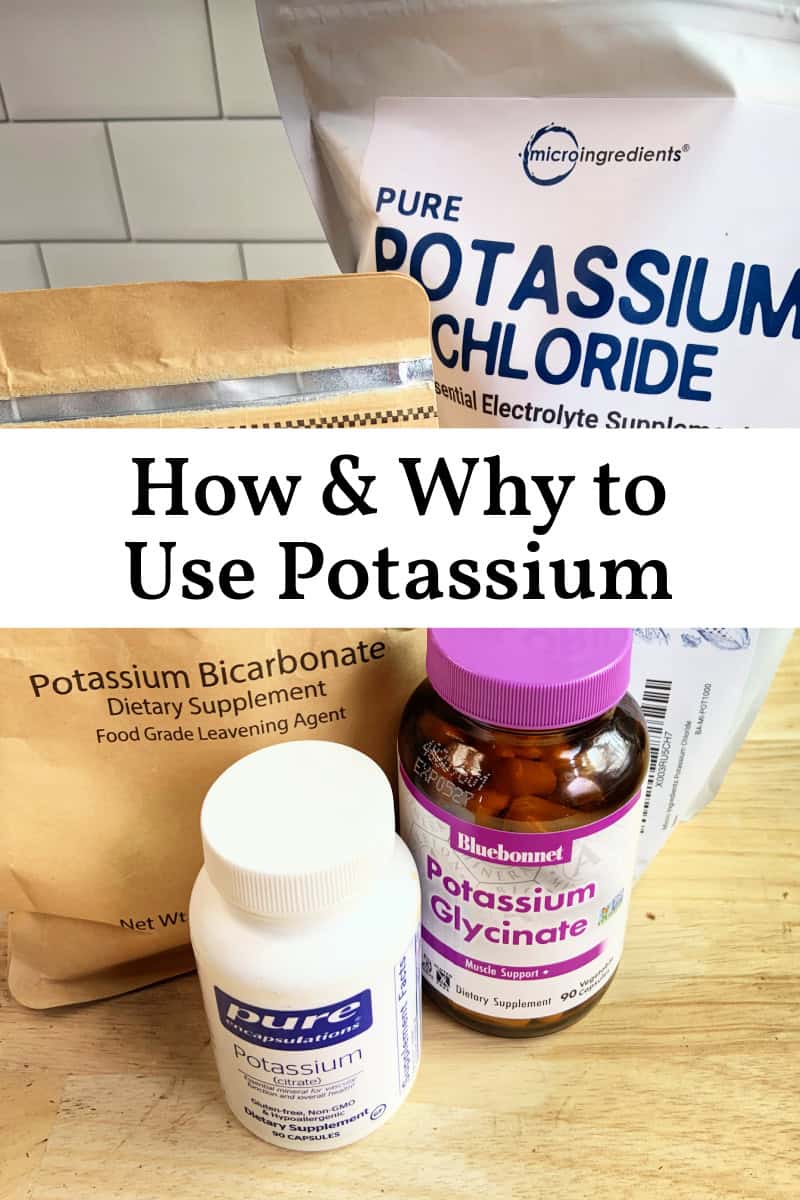
What kinds of potassium to try
Two food sources of potassium can be helpful for self-diagnosis and may also be helpful for symptoms. But for many, higher doses of potassium still may be needed, in which case taking a potassium supplement may prove very helpful.
The two food sources of potassium we use in our family are one, bananas, and two, my own Potassium Salt recipe, which really is using a potassium supplement on food, so it may or may not count as food. But either way, we’re using it as salt on our food, so it’s not taking a pill or a swig of something.
Beyond those two food sources, here are the supplements you may wish to experiment with, because everyone reacts a little differently to the kinds of potassium that are helpful and the dosages:
General dose information
Potassium is the one supplement that requires experimenting more than any other; it’s a very individual electrolyte that doesn’t get stored — and one’s need is based on toxicity and liver health.
Each person must determine which compounding works best for them, and how much is needed. The best method is: Begin with a small starting dose of the most commonly beneficial forms of potassium, and if it agrees with you, gradually increase to find your optimum dose.
(If a certain compounding doesn’t agree with you, you might experience a brief headache, lightheadedness, a stomach ache or GI issues, for example. Trial potassium with food and at least 12 to 16 ounces of water.)
How I personally introduced and use potassium
To use myself as an example, I used potassium chloride for years.
I started with 1/8 teaspoon stirred into my evening water. Gradually, I increased my dose until I reached a 1/2 teaspoon three times daily. After several years, I switched to a more alkaline potassium, bicarbonate, and I take 1/4 teaspoon of it both morning and night (because my diet is fairly acidic).
Thankfully, bulk potassium is inexpensive, so if you need to try a new kind, it may be that someone you love can use the kind that didn’t work for you. Most people will do fine with the more commonly used forms.
Minimum and maximum doses
Some people respond well to as little as 100 mg of potassium a day. Others will need quite a bit more to see benefits.
The National Institutes of Health tell us, “… potassium balance cannot be achieved with intakes less than about 400–800 mg/day.” They recommend an average of 3000 mg daily, more or less, depending on the individual, including food.
Potassium supplementation should not exceed 1600 mg daily. Most of us will use less than that.
We need to take in at least as much potassium as sodium.
Potassium chloride
The first sleep benefits I gained from potassium were with potassium chloride. I started at the lowest dose (1/8 teaspoon), 365 mg, and started sleeping better as I increased it. At some point, my doctor suggested I try Potassium Citrate, so I did … more on this just below.
Here’s the potassium chloride I use.
You can also make Potassium Salt with this form, and/or Potassium Water.
Potassium citrate
My doctor talks about minerals in the citrate form as being a little touchy: Our bodies may need the citrate form of a certain mineral, but then get enough.
I found that after taking potassium citrate for a couple of months, it started to give me headaches. At this point, I switched back to potassium chloride, and was fine again — still getting the great sleep benefits, but no headaches.
After about a year of just potassium chloride, I experimented with adding a smaller amount of potassium citrate again, and found that one small dose in the middle of the day was helpful for a time.
1/4 teaspoon of bulk potassium citrate provides 400 mg. Find inexpensive 99mg potassium citrate capsules here.
Potassium bicarbonate
Bicarbonate is a strong alkalizer, so it’s best used by those who know they run acidic or who have more acidic diets. Otherwise, it can imbalance the pH of the body over time.
Find affordable potassium bicarbonate capsules here. (250 mg capsules, so 500 mg for two capsules.)
Potassium gluconate
Convenient and a commonly used form, potassium gluconate is a great way to get this most important electrolyte into your system.
Cream of Tartar
Some people swear by this form of potassium; it’s their favorite. Mix into smoothies, or stir into water. Do not exceed one teaspoon of this form daily.
1 teaspoon cream of tartar provides 500 mg of potassium.
Find the best price on bulk Cream of Tartar here.
Those who take it report: It helps with blood pressure, helps one person stay off BP meds, mixes well into juice or water, is tart and a little salty, no upset tummy and works amazingly well.
Potassium glycinate
A good friend of mine takes this form of potassium and feels she may benefit from the glycine, as it helps her more than other forms of potassium.
Glycine helps many people with sleep issues, so it may be a good fit. This form of potassium is harder to source, but seek it out if you feel you need it. (Bluebonnet makes a product.)
How much potassium to take for insomnia
As mentioned, do not to go above 1600 mg in a day with supplementation (see how doses vary depending on the form of potassium below), or 5000 mg overall, including food.
That being said, our bodies do not store potassium, but too much can cause unpleasant symptoms, and none of us want that. (Excessive supplementation of 18,000 mg or higher potassium causes hospitalization, so we are much lower than that.)
I personally slowly worked up to the full dose nightly, because I got the best benefits from it (and I love salt!).
Salt to potassium ratio should be anywhere from 1:1 to 1:2, with twice as much potassium as sodium being the upper limit. (Several studies show us, “… high sodium and low potassium intakes are associated with a high risk of insulin resistance or diabetes.”)
Forms of potassium and dosages
Potassium chloride is less potent, so you need more milligrams to get the same effect.
For example, I take a half teaspoon of this form nightly, but I used to get the same benefit from 1/3 the milligrams of potassium citrate — yet, they both measured a half teaspoon.
In both cases, I started with the lowest recommended dose, 365 mg of potassium chloride, or 99 mg of Potassium citrate, and then increased slowly.
When to take potassium for insomnia
You may wish to experiment with taking potassium with dinner or directly before bed, which I found to be helpful.
Because potassium helps many people with constipation, you may find it helpful to take a smaller dose in the morning and a larger dose in the evening, or experiment to find what works best for you.
More tips on how to take potassium
- I find it’s necessary to take potassium with a full 16 ounces of water. If it’s too concentrated, stirred into less water, I sometimes get a headache.
- Eat food sources of potassium, too, depending on your diet: beans, peeled Russet potatoes, coconut water, green kiwis, prunes, raisins, bananas, green grapes and apples. (An apple has half the potassium of a banana, but still contains 200 mg of potassium. And apples are excellent for helping us detox and stay regular with a unique, gentle and powerful kind of fiber.)

Dorothy says
It’s rather complex with all the different forms of potassium available, but it’s good to know there are several options. I’ve probably been using potassium chloride for a couple of years or more, in water and in light salt with your recipe. I don’t mind the taste anymore. I generally take around an eighth teaspoon morning and afternoon, and a scant half teaspoon in the evening. I seem to sleep better and have noticed other benefits as well.
Megan says
Sounds perfect, Dorothy!! 🙂 🙂