I may receive a commission if you purchase through links in this post. I am not a doctor; please consult your practitioner before changing your supplement or healthcare regimen. As an Amazon Associate I earn from qualifying purchases.
How to Make Yellow Dock Tea for Anemia introduces the herb yellow dock, shares its herbal properties and how to make tea from it.
Yellow dock goes by many names, including Rumux crispus, Curly Dock and Garden Patience. Yellow Dock Tea is a decoction of the bitter but (sometimes) delicious root that can be a rich source of iron and highly bioavailable. This “iron wine” is a natural, herbal remedy for anemia.
Actually: The root contains approximately 30mg of iron per 100g. While this is a decent amount for an herb, it is generally used in combination with other iron-rich foods (like molasses or nettles that we’ll discuss!) to treat anemia effectively.
Herbalists prize yellow dock because: The iron it does contain is often “biochelated” or in a form that is readily absorbed by the body.
Several years ago I was diagnosed with anemia. My doctor put me on three cups of yellow dock root tea a day. This article shares how to make the recipe and when to use this effective root.
Jump to Recipe
What are the health benefits of yellow dock root tea
In addition to being a potent source of iron, yellow dock may have the following health benefits:
- aids low stomach acid
- helps the liver to regenerate and cleanse
- provides detox support
- improves digestion
- benefits immune system
- balances hormones (helps to eliminate excess estrogen)
- provides energy during menses
- supports healthy blood sugar levels
- is a prebiotic food, beneficial for colon health
- relieves constipation and diarrhea
- adds soil minerals to the diet
- used topically, helps with acne and psoriasis
- is excellent for arthritis and issues of inflammation
Yellow dock is a digestive stimulant that affects bile production. This increases the overall efficiency of the digestive system, allowing for better absorption of iron and other nutrients from the diet. It also helps release iron that is stored in the liver, potentially making it available for use.
The toxicity of bile and how to add activated charcoal
Because bile can be toxic with other compounds from the liver, I like to take it with hardwood activated charcoal. Thus, we get bile’s benefits, but we’re protected from its caustic components.
(Activated charcoal acts as a potent binding substance in the digestive tract, trapping toxins, bacteria and excess substances. It’s been shown to bind to bile acids in the intestine, preventing their reabsorption. This can be particularly useful if the stimulation of bile by the bitter herb causes digestive upset or if there is a high turnover of toxic components in the bile [which is common]. By binding to these substances, activated charcoal can prevent them from irritating the gut lining or being reabsorbed into the bloodstream, making it a “protective” agent.)
Find the best hardwood activated charcoal here. Starting dose is to stir half a teaspoon into a little water.
Increases uptake
Because yellow dock increases the uptake of other iron-rich foods, a powerful anemia remedy includes other iron-rich ingredients: burdock root, dandelion root, nettles and molasses. A dark brew made from these five ingredients is an effective approach to getting one’s iron levels up quickly.
In general, humans absorb less than 1% of the iron they consume. Adding yellow dock root to meals, or drinking this tea, can improve one’s iron levels more effectively than other methods.
Why not take iron pills
Iron pills often cause constipation or other side effects.
Additionally, it’s hard to know which kind of iron to take. Every doctor says something different, but taking a whole food source simplifies the decision with time-tested effectiveness.
What yellow dock tea tastes like
Yellow Dock Tea is strong — like what black coffee must taste like to a young child — bitter, dark and dry. The first time I tasted it, I was surprised, and thought: I have got to figure out how to make this taste good. (Otherwise, three cups a day is a lot!)
Getting the right ratio of root to water took some figuring. Sweetened, yellow dock becomes palatable. Because I’ve come to love this strong tea, I’m eager to share with you not only this whole food remedy, but also the recipe — how to make yellow dock tea delicious and enjoyable!
I share below (see the Recipe itself) how to make the herbal decoction — a remedy tea from a woodsy root — and then, what to do to make it delicious and more iron-rich.
Can yellow dock root be mixed with other herbs
Yes! Yellow dock is synergistic with several other herbs, including burdock root.
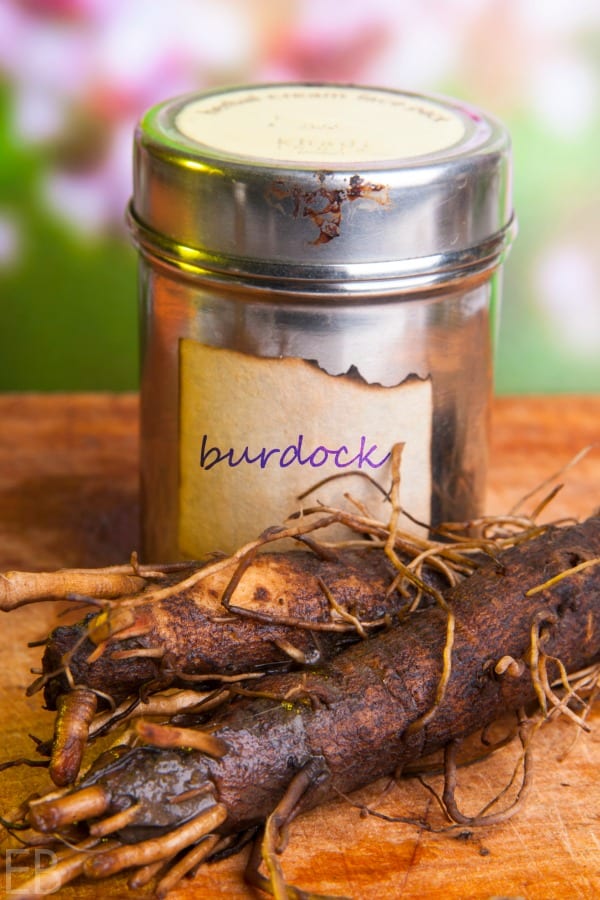
I add ground burdock root to yellow dock to make the simple brew more delicious and beneficial nutritionally.
An adaptogenic herb, burdock has been recognized for centuries for its unique cleansing and restorative qualities. Burdock helps with the breakdown of toxins and the elimination of waste. These properties align it well with yellow dock, which cleanses the liver. Burdock, too, is bitter, and it, too, stimulates the liver and gall bladder to produce and release digestive juices.
Burdock is also used to heal skin conditions, kidney disease and may be beneficial in cancer treatment and prevention.
For our purposes with this tea, burdock root is high in vitamin C. Vitamin C aids in the absorption of iron.
Find bulk, organic burdock root here. I use powdered burdock root in my kitchen and in this recipe. You can grind your burdock root in your coffee grinder, or find powdered burdock root here.
Two other herbs also work well with yellow dock:
- Dandelion root is high in iron and stimulates bile production. Dandelion gently improves liver and gall bladder health, then sometimes benefiting skin and hormone health. (Many other benefits are also attributed to dandelion, including its ability to reduce inflammation and its anticancer effects.) Find organic bulk dandelion root here.
- Nettle leaf is high in highly digestible iron, easy to assimilate. Nettle leaf is rich in minerals, may help to relieve stress and improve digestion. Nettle leaf is considered a superstar in treating anemia and the fatigue caused by iron deficiency. I include nettles in a variation you will find in the Recipe Notes below. Find organic bulk nettle leaf here. (For those reducing vitamin A in their diet for broader healing, omit this ingredient.)
Can you cook with yellow dock
Powdered yellow dock can also be mixed into curry powders. Curry with yellow dock added once a week is recommended by herbalist Ryan Drum to gradually improve one’s iron levels. He saw improvements in many of his clients with this simple dietary change.
Grind dried yellow dock root to a fine powder in your coffee grinder. (I have not found a good organic powdered product.)
Vanilla extract — optional
I sometimes make Yellow Dock Tea with vanilla extract, for two reasons: One, the vanilla flavor makes the dark beverage more palatable. Two, the small amount of alcohol in vanilla extract helps to pull the healing properties from yellow dock root.

Yellow Dock Tea for Anemia
Equipment
- saucepan
- strainer
Ingredients
- 6 cups water divided
- 3 Tablespoons yellow dock root
- 2 Tablespoons burdock root , ground to a powder (optional)
- 1 Tablespoon vanilla extract
- raw honey , coconut sugar, maple syrup or sweetener of choice
Instructions
- Boil 4 cups water, yellow dock and vanilla for 15 minutes.
- Turn off the heat, stir in burdock and cover.
- Allow the brew to steep for 30 to 60 minutes.
- Add remaining 2 cups water and reheat to serve.
- Pour through a strainer. Sweeten to taste with coconut sugar, honey or sweetener of choice.
Notes
Variation with dandelion, nettles and molasses:
- Use 8 cups water total.
- Boil 6 cups water. Add 3 Tablespoons dandelion root with the yellow dock root and vanilla (follow recipe above).
- Stir in 3 Tablespoons nettles with the burdock.
- Add 1 Tablespoon molasses with your sweetener of choice.
Other variations/herbs that taste good with yellow dock
I also learned to add hibiscus. High in Vitamin C, hibiscus adds a lovely, rich, fruity note and helps the iron to assimilate. To the recipe above, add 2 tablespoons of loose hibiscus petals during the last 10 minutes of steeping. If you wish, sweeten with raw honey. The addition of hibiscus makes a delicious cup of nutrient-dense tea.Nutrition

Find yellow dock root here and hibiscus here.
Can you drink too much yellow dock tea
Yellow dock is moderately high in oxalates. Yellow dock can be used in small amounts for short periods of time or intermittently. Sources warn it should not be consumed long term. Yellow dock should be avoided or used with caution when a history of kidney stones is present.
One of the best approaches to high oxalate foods and many herbs is to rotate them. Provide variety for the body to prevent excess.
Please consult your healthcare practitioner before beginning any new herb or healing protocol.
Regarding pregnancy, most herbalists agree that yellow dock may be safer than the ferrous sulfate found in iron supplements, which cause constipation. Ask your practitioner about using Yellow Dock tea or tincture (1 teaspoon daily, in divided doses) combined with iron and vitamin C-rich foods to gently and safely raise iron levels. (source)
Ryan Drum tells us that if you have diarrhea from yellow dock, you’ve probably had too much. That’s logical.
What if you don’t want to drink the tea? Is there an alternative?
If you prefer an alternative to tea, here’s how to make a tincture from yellow dock root.
Find a good Yellow Dock tincture here.
(And: Remember the idea of making a weekly curry with powdered yellow dock added.)
What’s a long term solution for anemia
The root cause of anemia varies patient to patient, but one new finding points to the liver’s capacity for vitamin A storage.
Glyphosate (the poison commonly used in conventional farming) impedes the body’s detoxification mechanisms, which may contribute to chronic vitamin A toxicity over time. (source)
Eating “the rainbow” (colorful foods like kale and red bell peppers), as well as super foods like liver or cod liver oil, adds excessive vitamin A. The theory of vitamin A toxicity speculates that the liver pushes iron out to make room for the storage of vitamin A. Excess vitamin A may cause not only anemia, but also eczema, (ironically) eye health issues, mental health issues, kidney problems and much more.
A temporary low vitamin A diet relieved my iron deficiency. While more testing is needed, it may be helpful to consider the Vitamin A Detox diet (read more here) as a long term solution for anemia.
Other factors in the causes of anemia include pathogen overgrowth, specifically SIBO, and Celiac disease or a gluten sensitivity. All of these resolve well also, with a low vitamin A diet.
How to have your iron levels checked
Where to start before you supplement? Iron is measured with a ferritin blood test. Doctors don’t always test for ferritin (stored iron).
Doctors’ recommendations for ideal levels of ferritin vary significantly, from 40-70 mcg/L to 70-150 for optimal health. Iron can be too low or too high. Ask your doctor for a copy of your blood work to see if you’ve been tested and what your numbers are.
Also ask your doctor for these iron values tested along with ferritin:
- Serum iron – Measures iron in the blood.
- TIBC (Total iron binding capacity) – Measures how well the protein transferrin can carry iron.
- %Sat (iron saturation) – Calculated by dividing serum iron by TIBC, providing the percentage of transferrin used.
(Serum ferritin can be falsely normal or elevated due to inflammation, liver disease or chronic infection. Combining it with TIBC and saturation helps distinguish between iron deficiency anemia and anemia of chronic disease.)
If the above three are elevated, then the blood and cells are saturated with iron, and it isn’t being used properly by your body. This could be attributed to liver or thyroid issues, B12 or folate deficiency. We shouldn’t supplement with iron until we understand these values.
If the %Sat and TIBC are low and serum iron is normal or low along with low ferritin, then it may be ideal to start supplementing with iron. These values can be checked every six weeks.
Other resources
After starting with a new doctor about four years ago, I learned about a supplement that balances iron: Lactoferrin. This solution worked well for my adult daughter. We used this product and followed the product’s guidelines for dosage.
Related articles you may like:
- Best Non Toxic Tea Kettles
- How to Make Tea in a French Press
- How to Use Colloidal Silver for Kidney Infections and UTIs
- Rethinking Gallstones: Bile Toxicity, and Zeolite Support
- 7 Reasons Coffee’s Unhealthy
Pin Yellow Dock Tea for Anemia here:
Additional Sources
1, 2, 3, 4, 5, 6, 7, 8, 9, and:
Ganora, L. Herbal Constituents
Tierra, M. The Ways of Herbs
Wood, M. The Earthwise Herbal

Raine Irving Saunders says
This recipe looks beautiful and amazing Megan! I really want to try this. When life slows down a bit, I am definitely putting it on my list for a to-do!! 🙂
Megan Stevens says
Wonderful. 🙂
Emily @ Recipes to Nourish says
This is great! I need to focus on boosting my iron intake. I feel this will really help my health. Have this pinned.
Megan Stevens says
So glad, Emily! Blessings.
Jessica from SimplyHealthyHome says
Yellow dock is so wonderful for iron boosting. Great post.
Megan Stevens says
Thanks, Jessica.
linda spiker says
As usual I have learned something from your blog! I have never heard of yellow dock before. Good to know!
Megan Stevens says
So glad. Thanks, Linda.
Renee Kohley says
this sounds pretty strong knowing those herbs! ha! but this is so good to know if i ever need it – do you know if this is ok during pregnancy? i was always anemic during preganancy – would be good to know if i can recommend it to pregnant friends.
Megan Stevens says
The sources I read said, yes, it was safe… BUT~ Here’s what Carol from Studio Botanica says, “Although some authors recommend using yellow dock root in pregnancy because it’s a good source of iron, I feel it’s best not to use this herb in pregnancy or while nursing because these are not good times to be detoxifying.
I love Yellow Dock for almost any other time!”
Shelley Brogly says
Special Precautions & Warnings:
Pregnancy and breast-feeding: Taking yellow dock by mouth is LIKELY UNSAFE in women who are pregnant or breast-feeding. It has laxative effects, which are not desirable during pregnancy. Also, the chemicals that cause the laxative effects can be transferred to a nursing infant through breast milk. ???
Megan Stevens says
Better to be safe, for sure! Thanks Shelley for addressing this issue. Another great source of iron is grass-fed liver pills, during pregnancy and nursing.
naturalfitfoodie says
Anemic.. check, low stomach acid ..check .. Two reasons I need to make this tea. Thank you so much for sharing Megan!
Megan Stevens says
So glad! You’re welcome!
Chloe says
I’ve never heard of this before. Thanks for sharing!
Megan Stevens says
Thanks, Chloe.
Rachel says
Gosh, seems like quite the healing concoction. 🙂
Megan Stevens says
Yes, strong in every way! 🙂
Rachel B says
So… where does one find yellow dock root? I’ve never heard of it before by any name. 🙂
Megan Stevens says
Hi Rachel, you can get it in bulk from natural food stores that have large bulk herb and tea sections. If that isn’t an option in your city you can use this Amazon link, which is an easy source and organic: https://amzn.to/2Llc4Ll
Jenn says
I couldn’t find it loose so I bought the ingredients in extract form. Any suggestions for ratios to make tea?
Megan Stevens says
Hi Jenn, sometimes tinctures have a recommendation on the side of the bottle. Does yours? Often it’s 30-40 drops thrice daily. But no, I’m sorry, I don’t have any experience with that form myself. Best wishes.
Yada says
Yellowdock good for so many other things as well. I will try this recipe as I have some powder left. I also have goldenseal and will have to see what I can do with it. I think you can make tea with it as well. Google is my friend. We shall see. lol
Natalie says
Thank you for this!!
Stuart says
I am interested in your discussion of herbs to deal with psoriasis. I am on prescribed steroids and anti-fungal creams (my dermatologist believes that some of the skin eruptions are fungal in nature) for more than 5 years. Your information and recommendations for yellow dock root and burdock seem to be worth a try but here is my problem: I have a “short gut” having had half of my small intestine removed as the result of a benign tumor. It left me unable to process all forms of dairy and soy. In addition I need to regularly consume binding foods (bananas, rice, dry toast) as a result of the surgery. I don’t want to address the psoriasis problem and cause an increase in bowel problems. What do you advise?
Megan Stevens says
Hi Stuart, I’m not a practitioner, so I can’t advise you. I recommend you find a great recommendation for a functional doctor. I do not believe that steroids or anti-fungals are safe for long-term use. But functional doctors are medically trained with a mind toward healing and wellness by natural means. Blessings and best of luck!
Stuart says
Thanks for the advice. I live near Concord, NH and about 1.5 hours from Boston. How might I go about finding a functional doctor. Any recommendations that you might have would be appreciated.
Megan Stevens says
Hi Stuart, here are two resources to get you started. Best wishes!!
https://www.functionalmedicine.org/practitioner_search.aspx?id=117 and http://drhyman.com/blog/2010/08/08/functional-medicine-how-to-access-the-future-of-medicine-now/
Hung Chau says
I wonder how often we can drink Yellow Dock Root tea? Anyone knows? Please help.
katerina says
hi!
i so want to try this recipe
can you explain in what way burdock is synergistic with the yellow dock?
thanks
Tiffany Jones says
This came just in time as I’ve recently been diagnosed with being anemic from heavy menstrual bleeding. I tried the variation with yellow dock, burdock, dandelion, and nettle since I already had all them on hand. All I can say is extremely bitter. So bitter I’m afraid to drink it…lol Hopefully, not too potent. Maybe I should’ve started with just the yellow dock and burdock.
Megan says
Yes, sounds true. I would start with the basic recipe, and then add other ingredients slowly, but don’t overdo the ratio of bitter herbs to water. Best wishes for recovering.
Shannon says
You can also add blackstrap molasses to increase the iron in this tea, plus it helps to sweeten it as well. ~*~
Suzanne says
My boyfriend is anemic but we are on a ketogenic diet. It hasn’t exactly helped his sleepiness (but it hasn’t made it worse). So he still naps a few times/day. Yet if he is eating meat most days, shouldn’t he be getting enough iron? Wouldn’t the tea be overkill?
Megan says
Hi Suzanne, you and your boyfriend should work with a functional medical doctor or a good ND to look at your boyfriend’s ferritin levels and go from there. Once you’ve seen his bloodwork, your doctor can help you assess what supplementation and diet are best. When someone has anemia, typically iron from meat is not enough to get iron levels back to normal, especially because the ketogenic diet focuses more on fat than protein. Hopefully your doctor will help you to look for the cause of your boyfriend’s anemia, which is the key ultimately to overcoming low iron levels.
Carol Little R.H. @studiobotanica says
Excellent article Megan. Thanks for sharing. I have used yellow dock in various combinations over 20+ years in herbal practice and it is indeed a wonderful plant medicine. It does pair well with burdock root for sure.. and I use it in formula for both anemic situations and constipation (for the mostpart) A gentle but definitely powerful herbal ally! Glad you found this helper.. and bravo to your doc!!
Megan says
Thanks Carol! Great to hear your experience!
Shri says
When is best to drink yellow dock tea? After meals or before meals?
Megan says
Hi Shri, great question! First thing in the morning on an empty stomach is best.
Schuyler Witman says
Thank you for your article. Another cause if anemia is heavy menstrual bleeding. As someone entering perimenopause I sometimes feel weak after a heavy bleed. I am looking for a personal medicine to take during this period of my life, and your article helped. I’m going to wild craft yellow dock, burdock, and dandelion roots from my area and experiment. I also might add Oregon grape root for its liver-related properties. Thanks for the info!
Megan says
Great, Schuyler. Thanks for sharing your insights and plan. Best wishes!
Sherree says
This is the best tea ever. .. So amazing and delicous, no sweetner needed. I am an expresso junkie and I believe I could give it up for this yummy tea.
I used powdered Dock root and powdered burdock, vanilla following the exact recipe and perfection!!
Thank you so much for the share!
I am not anemic. Can I have a half cup a day or do need to make a recipe once a month??
Megan says
Hi Sheree, so glad you love it! Thanks for sharing the specifics of what you did. I agree, it’s so delicious. I’d talk to your doctor about the right amount of iron for your body.
Taylor says
Hi there! Excited to try this recipe. Can this be steeped as a tea blend or do you have to steep in a pot for the 60 min? I want to make this for my sister and I know it would be much more convenient for her to make one cup at a time 😊
Megan says
Hi Taylor, good question. I haven’t done that before, but I suspect you could use powdered dock root, and steep for 15 minutes. I would start with 2 teaspoons powder for 12 to 16 ounces water and play with it to get the ratio right. You might also consider simmering the powder briefly before steeping.
Valerie Jones says
Can I use the powdered yellow dock at 3 tablespoons, or is that for the dried root for this recipe?
Megan says
Hi Valerie, you are right that it will be too strong. You might play with the amount for the powdered, but it should be about half the amount.
Carolyn says
How much vanilla? And the link to make the tincture is a dead link.
Megan says
Hi Carolyn, thanks for letting me know about the link. I just fixed it. The vanilla amount is in the recipe itself; it is 1 tablespoon. Cheers.
Jomirun says
I’m so glad I found this blog of yours Megan. I’m not a tea person but would love to try this tea to increase my iron levels as well as relieve constipation (my gall bladder had been taken out few years ago due to gallbladder stones and also around 7 years ago had right ovary taken out due to ovarian cyst).
I needed to ask Megan since recipe suggests to steep for an hour, does this make one cup of tea a day or?
Can I make it in bulk and have one cup a day for few days?
Thank you so much!
Megan says
Hi, happy to help. This recipe uses 6 cups of water, so it is a bulk recipe. You can certainly refrigerate any leftover from the first serving, and heat gently to enjoy following days. 🙂
James C Christensen says
Hi Megan! So I made the tea, and you are right! It is STRONG! I am going to be using it for kidney support. I have two questions.
Is it ok to drink it cold?
What is the serving size?
Thank you!
Megan says
Hi James, yes, it’s fine to drink cold. Serving size is 8 to 10 ounces, depending on how much water evaporates when the water simmers. Best to you!
Hélène says
Is it blackstrap molasses you’re using? If so, how much? I think 1 tbsp is usually reccd for a daily dose of blackstrap. Midwife told my friend to take blackstrap when pg w/twins. High in calcium also, altho how much actually absorbed is debatable.
Plus u add another sweetener too?
Megan says
Hi Helene, yes. I link to the blackstrap, plus the sweetener is there for the best flavor, but not necessary.