I may receive a commission if you purchase through links in this post. I am not a doctor; please consult your practitioner before changing your supplement or healthcare regimen. As an Amazon Associate I earn from qualifying purchases.
This Best Low Nickel Food List helps you to detoxify your body of a metal that’s behind many health conditions, not just contact dermatitis. The reason this food list is superior to other low nickel lists is:
- Many Low Nickel food lists are inaccurate. Nickel content varies in foods based on the soil the foods grow in — so it’s inaccurate and unwise to include certain foods that can be low to moderate in some regions but quite high in others.
- We also reduce other toxic metals at the same time for a more complete wellness approach, specifically copper, arsenic and manganese.
- I include information about optional binders in this article to help safely excrete nickel from the body as it detoxes.
- This post links to Low Nickel recipes.
- I share what our family eats on a low nickel diet.
- Feel free to ask any questions in the Comments section below.
- In addition to storing heavy metals to protect us from them, the liver and other tissues also store excess vitamin A, which is detoxed on the same pathways the body detoxes alcohol and drugs. This dietary approach (and list) reduces vitamin A for a more complete detox. (Read more here.)
How much nickel per day
For best results: A low nickel diet averages about 70 micrograms of nickel per day, about half of what most people consume — although some people have high nickel diets about four times the ideal intake.
Vegan and vegetarian diets tend to be high nickel.
Nickel detox symptoms
When you reduce your intake significantly, expect your body to begin dumping this toxic metal quickly. That’s why it’s important to go slowly, and to use binders.
Be prepared for a variety of detox symptoms including headache, hormone changes that can change one’s cycle (women), mood swings, GI digestion changes include bloating and more.
The symptom challenges that often accompany nickel detox don’t mean we should abandon the detox process. Rather, we do what we can to reduce symptoms and look forward to a rather quick overall detox duration.
Usually lasting between 3 months and one year (longer for weight loss goals associated with nickel toxicity), the body clearly wants to be rid of this toxic metal, so the overall time frame is really fast compared to other detox time frames.
Support during your nickel detox
I highly recommend my doctor, Dr. Garrett Smith, for support during your detox process. Find his videos on YouTube, or join his Love Your Liver program, where thousands of like-minded journeyers help each other through the same or similar detox processes.
What to avoid on a low nickel diet
On a low nickel diet, it’s important to heavily restrict “hyper-accumulator” foods that pull nickel from the soil, including:
- organ meats,
- whole grains (such as oats, buckwheat and whole wheat),
- legumes (beans, lentils, peas, peanuts and soy),
- nuts, seeds,
- licorice
- and chocolate.
Most multivitamins contain sources of nickel.
Other foods to avoid
Many plant foods are high in nickel, including these veggies:
- leafy greens (spinach, kale, lettuce),
- cruciferous veggies (broccoli, Brussels sprouts, cauliflower),
- asparagus, Jerusalem artichokes, artichokes and bean sprouts
- and canned vegetables.
Avoid all sources of inulin, including chicory.
While tomatoes, red bell peppers and eggplant are not high in nickel, they are all nightshades that cause inflammation over time. I recommend avoiding these while on a low nickel diet. (Tomatoes and red bell peppers are also very high in vitamin A.)
Avoid these fruits:
- raspberries, blackberries,
- figs, dates, plums,
- bright produce like mangoes, pineapple, apricots,
- most dried fruits
- and canned fruits.
Avoid using lemon juice or vinegar with anything metal, especially stainless steel.
Beverages to avoid:
- tea, and limit coffee to 1 cup,
- coconut water,
- beer, wine
- and tap water. (Instead use distilled or reverse osmosis. This includes one’s use of water for cooking pasta or rice.)
Other things
Stainless steel pots and pans are a significant source of nickel.
Try these pots and pans (I have them, and they’re good, plus a great value) instead, or these glass pots.
Consider switching to a glass water bottle (we have this one), instead of stainless steel.
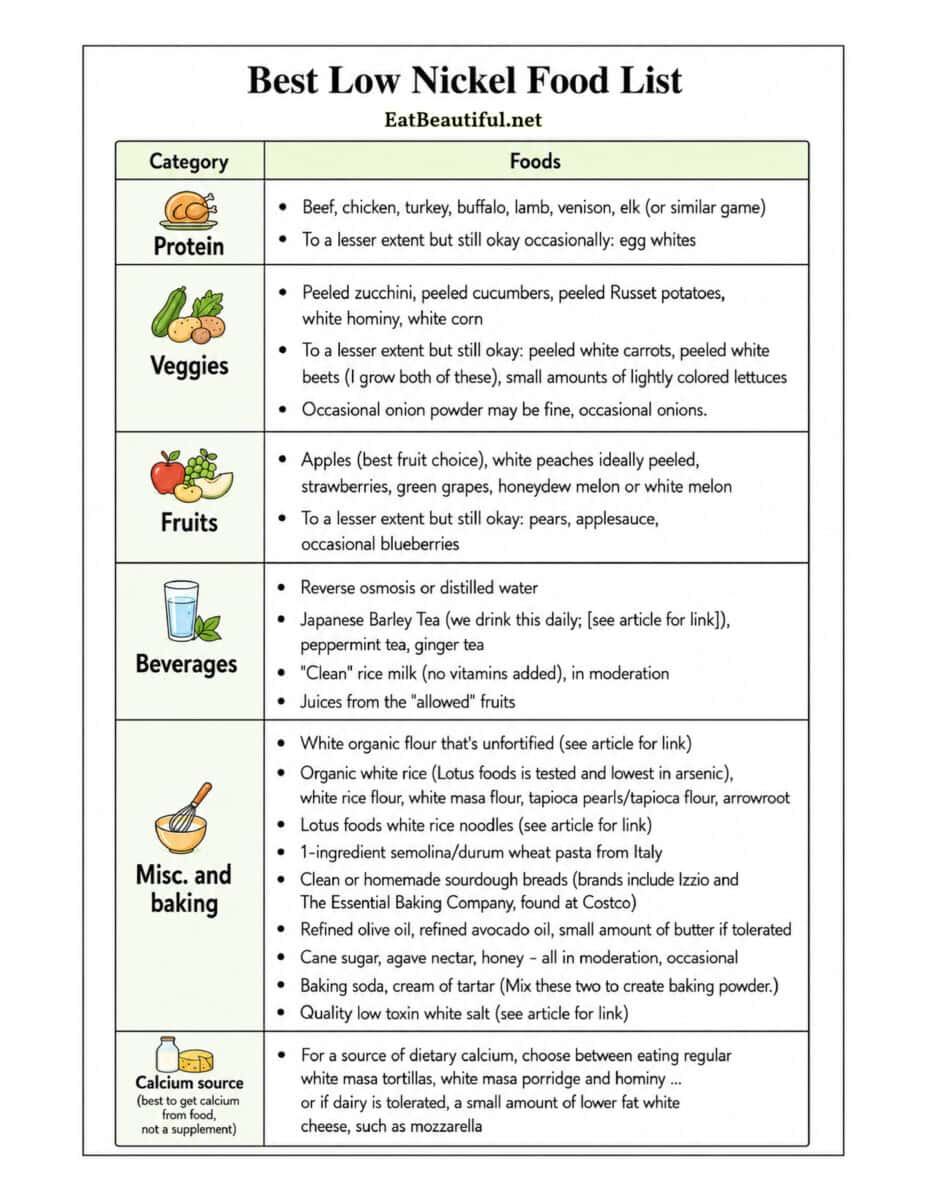
Low Nickel Food List with Free Printable PDF
Print the Low Nickel Food List PDF here.
Low Nickel (Low Toxin) Meats and Protein Sources
- Beef, chicken, turkey, buffalo, lamb, venison, elk (or similar game)
- To a lesser extent but still okay occasionally: egg whites
Avoid pork and seafood which have other toxins.
Low Nickel Vegetables
- Peeled zucchini, peeled cucumbers, peeled Russet potatoes, white hominy, white corn
- To a lesser extent but still okay: peeled white carrots, peeled white beets (I grow both of these.), small amounts of lightly colored lettuces
Occasional onion powder may be fine, occasional onions.
Low Nickel Fruits
- Apples (best fruit choice), white peaches, strawberries, green grapes, honeydew melon or white melon
- To a lesser extent but still okay: pears, applesauce, occasional blueberries
Low Nickel Beverages
- Reverse osmosis or distilled water
- This Japanese Barley Tea (we drink this daily), peppermint tea, ginger tea
- “Clean” rice milk (no vitamins added), in moderation
- Juices from the “allowed” fruits
It’s okay to keep 1 cup of coffee in your diet per day, but be careful what cooking vessel you use: No stainless steel. Consider using glass (like this or this).
Miscellaneous Low Nickel Foods and Baking
- White organic flour that’s unfortified (like this)
- Organic white rice (Lotus foods is tested and lowest in arsenic), white rice flour
- White masa flour (be sure it only has one ingredient/that it’s not fortified, like this heirloom product)
- Tapioca pearls, tapioca flour, arrowroot
- 1-Ingredient Semolina (durum wheat) pasta from Italy (here‘s an inexpensive one), or Lotus foods white rice noodles (here and here)
- Clean or homemade sourdough breads (brands include Izzio and The Essential Baking Company, found at Costco)
- Refined olive oil, refined avocado oil, small amount of butter if tolerated
- Cane sugar, agave nectar, honey — in moderation, occasional
- Baking soda, cream of tartar (Mix these two to create baking powder, if needed.)
- Quality low toxin white salt (like this)
What do I eat personally
I thought it would helpful to tell you what I eat each day! My husband, our 8-year-old daughter and I all do a low nickel diet. We eat (always choose organic):
- Lots of beef (mostly ground meat and stew meat), chicken, occasional lamb, turkey, “clean” deli meats and “clean” sausages
- Occasional egg whites — in baked goods, to make fried rice or for a quick protein source
- White rice, white rice noodles; white rice flour and sticky “sweet” rice flour (I bake with these.)
- Semolina pasta from Italy (Be sure yours has just one ingredient, no fortifications.)
- Sourdough bread for sandwiches; and homemade sourdough baked goods (I use King Arthur white flour.) — I make sourdough pancakes and muffins often.
- White masa and related: porridge, tortillas for tacos, posole, hominy in soups and stews
- Lots of apples for snacks, occasional bananas (not more than one per day), pears, strawberries
- Note: If you like apples, it’s recommended to eat even two to three daily, as they’re also a great source of soluble fiber, which is important when detoxing, to keep up regular daily bowel movements.
- Cucumbers for snacking and sandwiches, white corn for soups and stews, occasional lettuces (like one piece on a sandwich), occasional peeled zucchini
- Condiments: refined avocado oil, refined olive oil, all-fruit strawberry jam made in France, occasional ginger, baking soda, quality salt, dill weed, small amounts of agave nectar or pale honey
- Drinks: this barley tea, homemade lemonade/limeade (very occasionally)
At breakfast, we always start with a big serving of meat, about one third pound each. Then we enjoy toast or pancakes with hot tea.
For lunch, we most often do sandwiches, fried up sausages, wraps or leftovers.
For dinner, I make lots of: rice bowls, pasta with meat, tacos and soups or stews.
Include dietary calcium source
I really enjoy and emphasize sources of white masa/hominy in our diet because it’s one of the only sources of dietary calcium on a low nickel diet.
Alternately, if dairy agrees with you, you may wish to include a small amount of low fat organic dairy (be sure no vitamin A or vitamin D are added), such as mozzarella cheese or non fat yogurt (I like Nancy’s brand best for low toxicity and ease of digestibility. Avoid any yogurt with streptococcus thermophilus, labeled: s. thermophilus. A2A2 would be fine also, but the products all use the s. thermophilus probiotic that creates more retinoic acid in the body. To make your own yogurt use this one strain, or this one.) We avoid dairy altogether at this stage in our diet because it’s a significant source of vitamin A.
For additional supplemental needs on a low nickel diet, please read this article (coming very soon …)
Low nickel recipes
Here are some low nickel recipes to get you started:
- Rice Flour Banana Muffins
- Healthy Masa Porridge
- Rice Flour Porridge
- Crispy Beef from Stew Meat
- Healthiest Congee Recipe (Choose the white rice option.)
- Carrot and Beef Savory Pie (Use white carrots.)
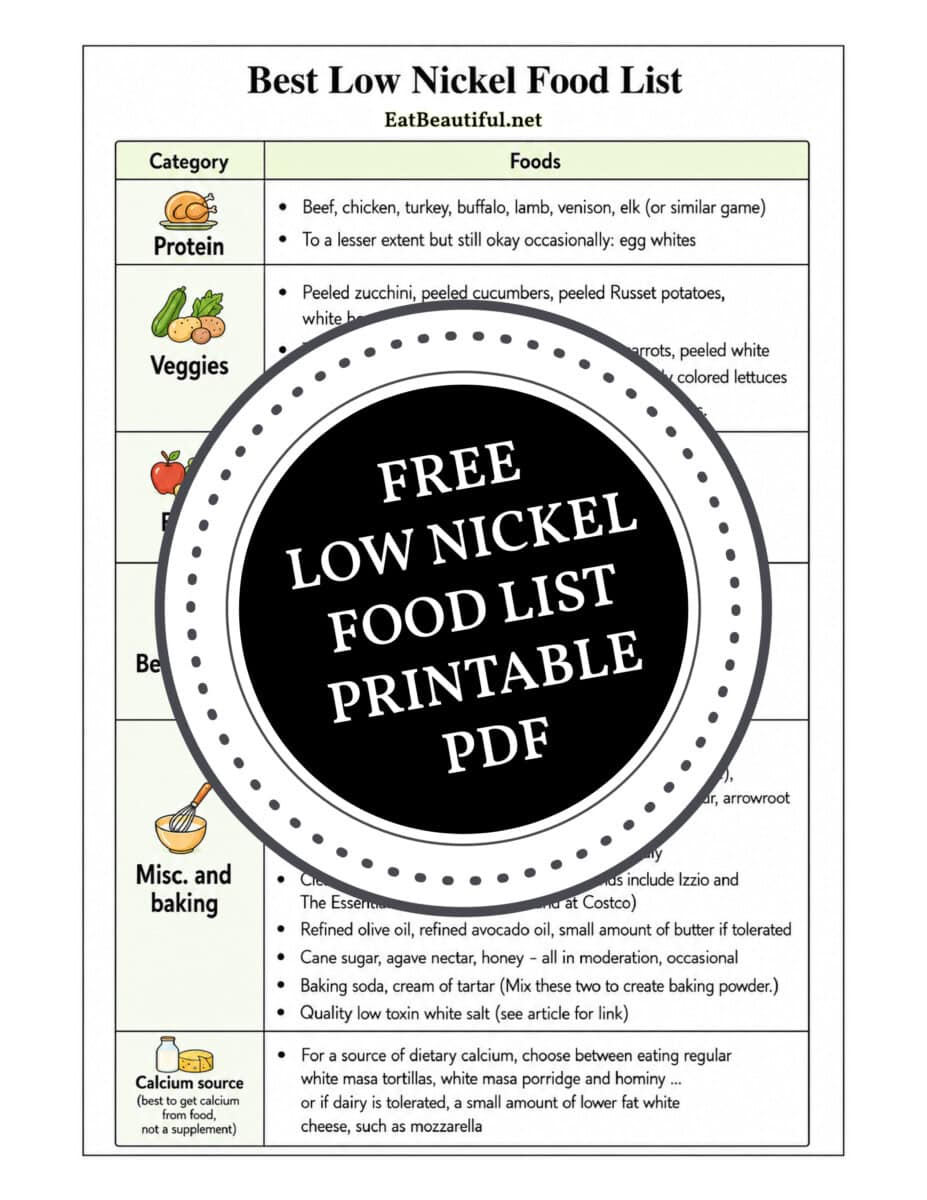
Pin the Low Nickel Food List here:

A says
Hi Megan, a few questions, please:
1. Could you provide links to the literature on weight loss on a low nickel diet?
2. Why is barley tea ok if barley/grains are not?
3. Re the King Arthur flour – is this ok? I’ve gotten mixed answers since it is hard wheat, trying to figure out if that is whole grain or refined. I’ve also been seeing on some newer bags at the store them starting to add barley, just FYI to check your batch!
4. You say white masa is ok. What about blue?
Thank you!
Megan says
Hi A, wow, you saw this article RIGHT when it published, very fun. 😉 Okay: 1) Please see Dr. Smith’s YT videos on the topic also. I credit him with finding the studies, and what a great job he’s done first understanding and then sharing the information. Here’s one study. We see in the studies that while close to 15% of the general female population may have nickel toxicity (although it’s likely much higher because testing often can’t accurately gauge toxicity until after it’s detoxed), closer to 60% of overweight women are nickel toxic! Wow, that really helps us to understand that fat holds onto toxic metals to help protect us from them. We need to lose the metals to lose the weight. More studies: here, and here (improves metabolic markers).
2) I can’t tell you the exact why except that barley itself is sometimes low in nickel, and that it may be a quantity issue or a sourcing issue, where it’s grown.
3) Yes, King Arthur white flour or organic Italian white wheat flour are both okay. They are refined white flours that come from wheat, but they’re not the whole grain.
4) Blue masa is higher in nickel, so avoid it.
You’re welcome, my pleasure.
MAGGIE WILLIAMS says
I’ve been using almond milk for years, but am avoiding it because of my issues with copper, vitamin A, and now nickel. Can homemade rice milk from organic rice be an option? We don’t drink it, but I would use it for making sourdough pancakes and waffles, and occasionally with cereal.
Megan says
Hi Maggie, yes. Can you make your homemade rice milk with white rice? If so, it’s a great option.
L. says
What about (wholegrain) rye? According to the Nickel Navigator it is low nickel.
Megan says
Hi L, What Dr. Garrett Smith advises, I think wisely, is to avoid all whole grains because they vary depending on where they’re grown, and in general, whole grains are high in nickel. However, depending on where you are in the process, and what your other dietary/wellness goals are, you could include it in your diet while eliminating all of the other sources of high or moderate nickel, and see if you’re making progress. As long as you’re below a certain level daily, it could be fine. That would be one way to test it on yourself. I personally avoid it for now, because I also do a diet that’s low in copper.
L. says
Hi Megan, Thank you! I will take it all into consideration. The hardest part is finding alternative fiber options that work for me.
Kristen says
Where does coconut fall in this?
Megan says
Hi Kristen, Coconut contains a variable amount of nickel, typically averaging between 0.5 to 3.0 parts per million, which categorizes it as a moderate to high-nickel food. Because plants absorb metals from the soil, exact nickel levels fluctuate based on the geographic region and farming conditions. Refined coconut oil can be a fine choice, but I avoid coconut itself and coconut water. Coconut milks vary, but overall, better to avoid.
Jonathan says
Hi Megan,
Very interesting article. I really appreciate that you took the time to write it and share it with us. I am also looking forward to watching Dr. Garrett Smith / The Nutrition Detective’s livestream about nickel.
Just to make sure that I understand everything correctly, am I right in thinking that if someone wanted to experiment with a low-nickel diet (while also keeping vitamin A and copper relatively low), the diet could look something like this?:
Grains:
White rice
Masa (white)
Proteins:
Beef
Buffalo
Wild game
Lamb (fat removed)
Chicken
Turkey
Egg whites (to a lesser extent, but still okay occasionally)
Vegetables:
Peeled zucchini
Peeled cucumber
White carrots
White corn
Fruits (if tolerated):
Peeled apples
Bananas
Green grapes
Miscellaneous:
Clean white salt (such as Maldon or Jacobsen Salt)
MSG
Psyllium husk
Sunfiber
Macadamia nuts?
Am I understanding correctly that the foods above would generally fit within a low-nickel approach, or have I missed something important?
In my own case, if I decided to experiment with a low-nickel diet, I could easily remove rolled oats and brown rice from my diet. I can also see from the article that beans are considered high in nickel.
That said, I honestly love white beans, especially navy beans, great northern beans, and cannellini beans.
As I remember hearing Dr. Garrett Smith mention in some of his older videos, beans are the “king of soluble fiber,” and soaked, pressure-cooked beans have helped me in many ways.
I actually grew up without eating beans at all. It wasn’t until I found Dr. Garrett Smith that I started eating beans. If I had to choose only two foods to live on, I think it would be white beans and beef.
If I understand correctly, oats are also one of the higher dietary sources of nickel, and they are relatively high in copper as well. Therefore, oats may be one of the soluble-fiber foods that a person experimenting with a low-nickel and lower-copper diet might consider eliminating, along with brown rice.
Regarding fruit, I have personally found that I feel better without bananas and apples in my diet.
From what I have read, Cavendish bananas from companies such as Dole and Chiquita (both organic and conventional) are artificially ripened using ripening agents after harvest. I have also read that apples are treated with sulfur-based products during production, and that copper-based fungicides are commonly used in some conventional and organic farming systems. Copper sulfate is also used in certain agricultural practices.
In my own experience, peeling apples did not seem to make a difference. Whether that observation is correct or not, I simply found that I felt better after removing apples and bananas from my diet. Instead, I get my supplemental potassium from potassium chloride powder.
Thanks again, Megan. I appreciate all the work you put into this website, and I look forward to hearing your thoughts whenever you have time to reply.
Megan says
Hi Jonathan, I’ll just make a few corrections: no psyllium, no macadamia nuts. But Yes also on: white sourdough bread with clean ingredients (no fortified flour), semolina pasta from Italy (one ingredient, also called durum wheat). And 1 banana a day is the limit (for other folks’ informational needs, not yours necessarily). You are very right about the copper sulfate, and other insights. Dr. Smith speaks often in the nickel videos about the copper now used in fertilizers. No need to eat apples, except that for many people when they remove beans, they need another good food fiber source. But I agree, for you not to eat them if you don’t feel well with them. One option for you would be to give up oats and brown rice, and keep the beans in. Any removal of a high food source of nickel can have significant results, and the symptoms can often be quite pronounced and uncomfortable when we take out too much nickel all at once. It’s different for everyone. Sometimes supplemental binders help a lot, and for others, they don’t. The detox is usually easier for men than woman, and for some men, the detox is no big deal at all; that could be you. (Side note, for the last 15 years-ish I have eaten almost no fruit because it gave me symptoms. Now after 7 years on this diet, I’ve been able to add back in organic apples; I peel mine. I feel really thankful for them because the low nickel diet has been hard on my body, and I can’t eat beans right now. But, Dr. Smith says many people get benefits just by changing one or two factors, like giving up oats, and changing their pans or water source.) I think you’ll get benefits from just removing the two grains. And, I agree: meat and beans are my two favorite foods. But I do love bread, too, lol. SO, the only other thing to be aware of, when you asked if you’re missing any important piece is: Dr. Smith now cautions that people use Pectasol or Pectaclear for a month before beginning the diet because many people get major symptoms when they start (including men), and this may help. So if you don’t plan to use these binders, I’d keep that in mind and go slowly. Let me know if you start and are struggling with new symptoms if you need any support.
Rita says
What do you spread on your bread for sandwiches? I switched to hummus for low vitamin A, but if beans are out…Sandwiches are kind of a go to in our house. We usually do bread, hummus, cucumber and meat. Also, are they any sauces you make for pasta or rice bowls? Thank you for taking the time to post this information. I appreciate all of your effort.
Megan says
Hi Rita, sure, and it’s a good question. I use a few things: ginger jam, olive oil + salt and/or apple butter (+ iceberg lettuce). These are all really good IMO. I just buy the organic brands of ginger jam and apple butter. I used to do what you did, but somewhere along the line, I discovered ginger jam. It’s really good with poultry, like turkey or chicken, but it works okay with beef, too. The apple butter I figured out more recently. Regarding pasta, I save the pan juices after roasting chicken, including any fat, and it makes a great pasta sauce. I cook up ground meat to go with the pasta, and sometimes add another ingredient like sauteed peeled zucchini or white corn. Re rice bowls, coconut aminos and tamari are both okay, in moderation, and only if tamari agrees with you. I also use pan juice or a little fat with my rice bowls. I hope that helps! 🙂
Rita says
Thank you for getting back to me so quickly and for all of the wonderful ideas.
Megan says
My pleasure, Rita. 🙂
Sally says
Hi Megan. Thank you for this post. Are you willing to share your sourdough pancake recipe?
Megan says
Hi Sally, yes, I need to publish the best version. The hold-up is that I make them almost every morning without a recipe, so they vary a bit day to day. Maybe this week I can get around to measuring and getting the best version recorded. Coming soon … 🙂
Sally says
Hi Megan. This article is SO helpful! Tell me kindly, will Pectasol or Pectaclear interfere with other binders, namely Zeocharge? Is it necessary to take them both (Pecta-product and Zeocharge), or do they essentially do the same thing?
Thank you!
Sally
Megan says
Hi Sally, I’m so glad it’s helpful. You don’t need to take both Pectasol and Pectaclear, but I did appreciate trying both to see which I like more. If you’re only going to choose one, Pectasol is considered more powerful because of the alginate, as Pectasol has two ways it binds nickel (also the modified citrus pectin). Either or both work great alongside Zeocharge. My family takes both, and they do have different benefits. Zeolite can also help with any upset stomach that may happen from the nickel.
Randi Roth says
I’d love to hear what you are doing for the kids as far as the diet is concerned, Also the binders, how do you dose them for you and the kids, does the timing matter? thanks!
Megan says
Hi Randi, Happy to: One route for kids and dosing is to do 1/3 an adult dose, with some exceptions, of course. My 8 year old takes 5g zeolite daily, 1 PEA (500-600mg) 3x daily, up to 1 scoop Pectasol 2x daily, Mg lotion nightly, 1 Mg capsule, she doesn’t take zinc but eats a lot of beef, small amounts of molybdenum and 50 mcg selenium. Potassium, she takes a 1/3 dose. Niacin, we’re doing 200 mg 3x daily (a pretty high dose, but probably fine for any child with symptoms where the goal is to overcome something, suggested by Kelsey, uniquely for our daughter); she also does the SunFiber (1/2 scoop) and reuteri probiotic combo, 2 large capsules of MSG, and 3-5 drops K2-MK4. So just about everything!! Oh, and charcoal: 1/4 teaspoon each morning, mixed with the potassium and zeolite. I give her everything in the morning, except those supplements that she gets 2-3 times daily. I don’t give her anything before bed other than the final PEA dose, niacin and Mg lotion. The only reason to do zeolite or activated charcoal at night instead of the morning would be if they weren’t sleeping well and you felt a nighttime bile dump needed to be adsorbed, or if you just preferred. My other child, age 17, isn’t doing low nickel, but I keep him on the basic minerals, zeolite, charcoal and MSG. He does his binders and Mg at night, and the rest I give him in the morning. I hope that helps!
Randi Roth says
Thanks for answering so quickly! I just started avoiding these things in my diet, so I’m still figuring out the whole VAD thing, but so far I’m feeling better. I look forward to seeing more recipes tailored to the low A and nickel. Please let me know if there is a separate subscription for emails pertaining to this topic. Keep up the good work!
Megan says
Thanks, Randi! So glad it’s helpful and that you’re feeling better. No, just one newsletter at this point. 🙂
Tanya Hurwitz says
Megan-
What a fun journey on LYL and I truly appreciate your articles summarizing GS research. I refer to your articles often and value this resource. Love your passion and commitment to living your best life and helping others on the way 🙏 I am ready to ramp up more on the program… I didn’t have the band width to jump into low nickel and thank you all for paving the way. It was one of your interviews with GS that inspired me to join initially. Your testimony and healing journey are inspirational 💗 love that your family is on it too 🙌 CHEERS
Megan says
Hi Tanya, thanks so much for your kind words and encouragement. It’s great to hear you’re moving forward, and I hope you won’t be discouraged by the ups and downs that come with detoxing nickel. It’s certainly worth it, and understandable that nickel would make our lives difficult at times as it detoxes. Super happy that what I share has inspired you!! <3 <3 Blessings as you proceed!
Keisha says
Hello! I’d like to thank you for your resources here on low-nickel living. I’m wondering if you could speak to water remineralization. I’ve started drinking distilled water, and I’m concerned that I’m missing out on the minerals that have been stripped (potassium, calcium), especially since my diet has become so strict. I do already take 400 mg magnesium glycinate nightly, so not sure if I need to be too concerned about that mineral. Thanks for any insight you can give!
Megan says
Hi Keisha, happy to help. Yes, that’s wise of you. The magnesium you’re taking is good. Oral calcium supplements can raise blood calcium levels, disrupting the body’s calcium regulation. Excess calcium increases urinary calcium excretion and the risk of kidney stones. High calcium levels can also suppress parathyroid hormone and reduce the body’s production of active vitamin D. So for calcium, it’s best to stick with calcium foods. This can either be an organic mozzarella/quality yogurt source, or here’s a list of vegan calcium sources. Regarding potassium, it’s great that you have it on your radar because it’s often overlooked but important. I have several potassium articles on my site as a result. How and Why to Use Potassium shares the options and also links to related articles that are helpful (how to make potassium salt, potassium water, DIY electrolyte powder and even which salt is the cleanest). Best! 🙂