I may receive a commission if you purchase through links in this post. I am not a doctor; please consult your practitioner before changing your supplement or healthcare regimen. As an Amazon Associate I earn from qualifying purchases.
If you ever look at ingredient labels on grocery items, you’ve probably seen it often: Vitamin A Palmitate. It’s a common additive, but why? Vitamin A Palmitate poses dangers from regular or excessive intake, leading to toxicity. When no one is deficient in this additive, why is it added to our foods?
Many commercial forms of this synthetic vitamin A also contain the preservative Butylated Hydroxytoluene (BHT) — but it goes unlabeled — which is associated with its own set of health concerns.
The hidden risks of Vitamin A Palmitate
Vitamin A palmitate — also known as preformed vitamin A — is commonly added to fortified foods like cereals, milks, bread, sugar and cooking oils.
(It’s easy to grab cereal, bread, an oat milk or an almond milk at the store, and not realize it’s one of the ingredients! You might even think to yourself: There’s such a small amount; it’s probably fine.)
As a fat-soluble nutrient, vitamin A is stored in the body’s tissues and, over time, can accumulate to dangerous levels, particularly when consumed regularly, via supplements or fortified products.
This accumulation can cause a toxicity called hypervitaminosis A, characterized by symptoms ranging from nausea, blurred vision, dry skin and hair loss to more severe outcomes such as liver damage, bone pain, osteoporosis, thyroid dysfunction, weight gain, intracranial pressure elevation, kidney disease, prostate cancer and more.
Vitamin A is no longer on most nutrition labels, so we don’t know how much we’re getting
Compounding the concern of hidden vitamin A intake is the fact that many staple foods are fortified without transparent labeling.
In a notable regulatory shift, the U.S. Food and Drug Administration removed vitamins A and C from the list of mandatory nutrients on Nutrition Facts labels, reasoning that deficiencies are now rare. These vitamins may still appear on labels, but only voluntarily.
If deficiencies are now rare, why is so much of our food still fortified with vitamin A — since it’s been shown to: 1) accumulate and 2) be toxic?
Vitamin A risks to mother and baby
Importantly, high intake of preformed vitamin A is teratogenic — meaning it poses serious birth-defect risks. For this reason, women who are pregnant or planning pregnancy are advised to avoid high-dose vitamin A supplements and regular fortifications altogether.
Examples of ignorance on this topic include the spike in jaundice cases in the U.S.
Jaundice is a reflection of how toxic the mother’s liver is with vitamin A. Overall jaundice increased between 1997 and 2012 by 65%! Cradle cap is also a side effect of poor liver health in the mother, and it’s also on the rise.
(Vitamin A is yellow or orange. We observe that jaundice and cradle cap — as well as a diseased liver — are yellow or orange. The body is trying to detox through the skin with these conditions. Exposure to sunlight creates vitamin D which helps the skin to detox, which is why these conditions improve when exposed to the sun.)
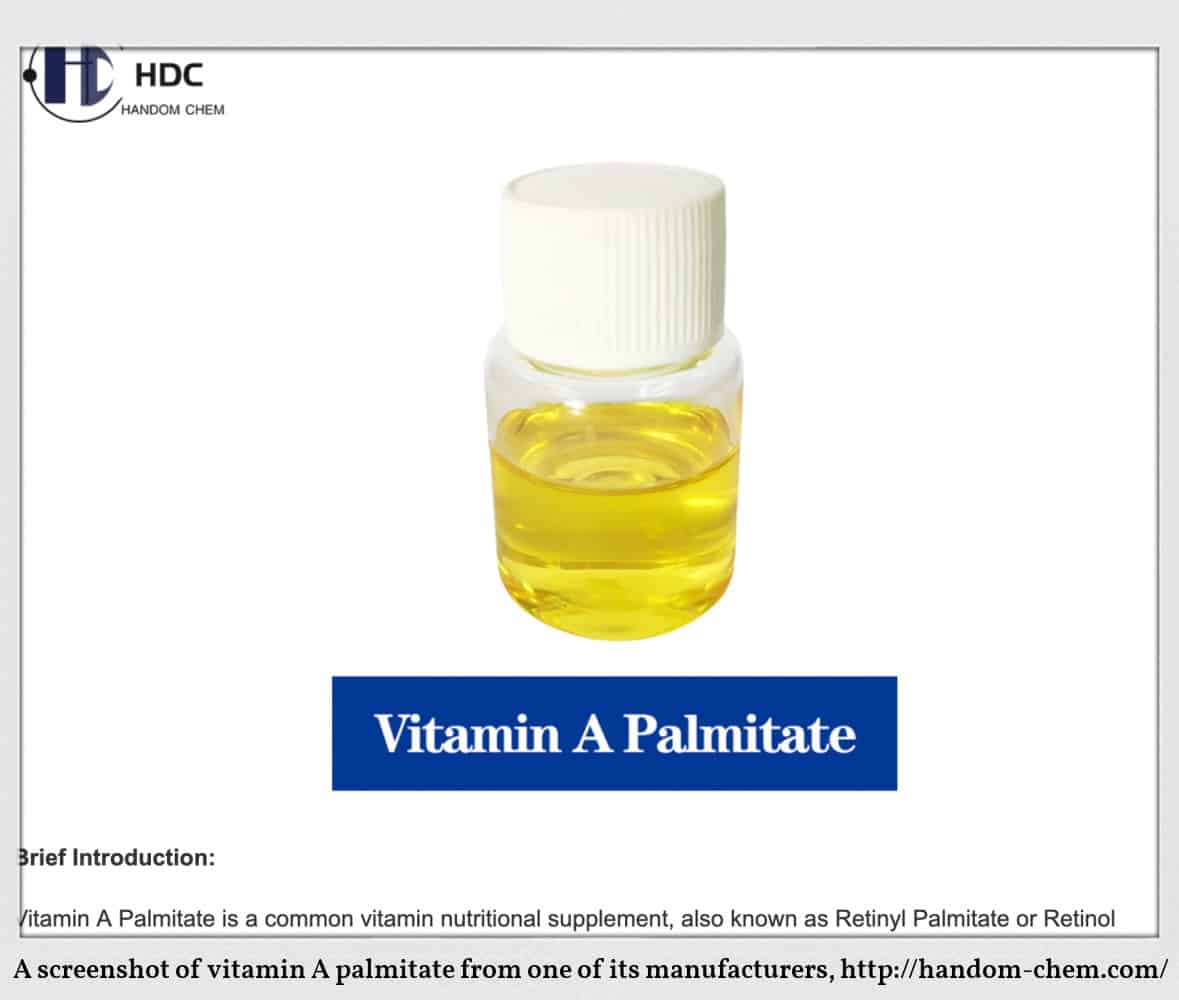
Topical dangers of vitamin A palmitate
Topical exposure to retinyl palmitate (a close relative of vitamin A palmitate), found in sunscreens and lotions, poses its own risk profile: It can generate free radicals, which may accelerate skin lesion or cause tumor formation.
Risks of BHT in fortified foods
Butylated hydroxytoluene (BHT) — a synthetic preservative frequently used in foods containing vitamin A palmitate — raises additional concerns. BHT is frequently used in foods with vitamin A palmitate because it acts as an antioxidant to prevent the vitamin/compound from degrading.
BHT isn’t always listed on the ingredient panel when added via packaging, where it can migrate into the food. This makes exposure less obvious to the consumer.
Manufacturers intentionally add BHT to the food or its packaging, so it’s actually separate from the vitamin A molecule; but, it’s not always labeled separately, or at all. When you see Vitamin A Palmitate listed among the ingredients, know that hidden BHT may be there as well.
BHT migrates into food both before and after a package is opened. (1, 2, 3, 4)
Key health concerns linked to BHT include:
- Endocrine disruption: BHT has been shown to mimic estrogen, influence testosterone and disrupt thyroid function. BHT exposure can manifest in mental health challenges, but consumers have no idea what’s causing their symptoms.
- Possible carcinogen: While BHA (a related compound) is classified by the National Toxicology Program as “reasonably anticipated to be a human carcinogen,” animal studies indicate that BHT may act as a tumor promoter.
- Wide exposure: It’s commonly found in cereals, cooking oils, chewing gums and other processed foods.
- Labeling opacity: When added to packaging rather than the product itself, BHT may escape labeling entirely.
Among the more insidious effects are subtle, chronic symptoms — like persistent fatigue, dermatitis (eczema), vision issues, mood disturbances such as depression, mental fog, thyroid imbalances and even kidney problems. These often go unrecognized as related to vitamin A accumulation or preservative exposure.
What can consumers do

Practice label vigilance. Actively read ingredient lists and Nutrition Facts. Be aware that vitamins A and C may no longer be shown — even in fortified products.
Limit fortified processed foods. Cutting back on fortified milks, breakfast cereals, chewing gum and similar items helps reduce exposure. Look for processed foods with minimal and only natural ingredients (no vitamins added).
Be cautious with supplementation. Avoid supplements containing vitamin A, especially in high doses.
Listen to your body. If experiencing unexplained symptoms — skin issues, mood fluctuations, fatigue, kidney or thyroid issues — consider dietary patterns as a possible contributor.
Consider a temporary vitamin A “detox.” While evidence may seem anecdotal, a growing community reports benefits after eliminating high-vitamin A foods. This community now numbers in the thousands. A growing mass of studies shows the toxicity of this “vitamin”. (1, 2, 3, 4, 5, 6, 7, 8, 9, 10 …)
Conclusion
While fortification policies aimed to improve public health by preventing deficiencies, they have inadvertently increased risk factors associated with vitamin A palmitate — additionally so when paired with under-disclosed preservatives like BHT.
Recognizing the risks of accumulation — including hormonal disruption, organ damage and carcinogenicity — is essential.
Consumers can empower themselves through proactive label reading, cautious dietary choices and symptom awareness.
The growing interest in vitamin A-focused dietary adjustments underscores a broader need: better transparency in food composition and a wiser more careful approach to fortification.
Scientists now understand that the body converts all forms of vitamin A into retinoic acid to make them active — and that’s when vA becomes dangerous to surrounding tissue. Surprisingly, our bodies can’t tell the difference between synthetic and natural vitamin A; chemically, they’re the same. Learn more about this, and the general dangers of ALL vitamin A here.
Pin The Dangers of Vitamin A Palmitate here:


Margaret Sanders says
Where is your starter sour dough receipe.
Megan says
Hi Margaret, I don’t have a starter sourdough recipe on the blog. I just followed the standard protocol for making mine. I have an oat flour starter.
Megan says
Hi Margaret, another reader is requesting this as well, so give me about a week, and I’ll publish that (I want to provide a few options). 🙂
Roberta Johnson says
Just a question about the recipe, would Redmond’s Himalayan Pink salt work? And if not, why not.
Megan says
Hi Roberta, which recipe are you referring to?
Mandy says
Who is distributing this product? Can we send a letter to all food corporations to cease using this product? I’ve been very disturbed by the uptick in the use of this pseudo vitamin. As soon as we decry one toxic product, they dump a new one on us. Follow the money trail? Thanks for this article.
Megan says
Thanks, Mandy. Yes, it’s super disconcerting. One wonders what the motivation is, as it’s bizarre to add more ingredients to a recipe when they’re not needed, and there is zero vitamin A deficiency in our country which is why they took it off the nutritional label of all packaged/processed foods.
Jari Serra says
You say the ingredient isn’t needed, but I’d like to hear what the companies’ stated reason is. Companies don’t spend money unless it serves them in some way. Does it lengthen shelf life? Does is make textures softer? I assume it’s not because of fortification, since they’re not required to list vitamin A on the label any more. I’d really like to know why they’re doing it, if you know.
Megan says
Hi Jari, unfortunately, it’s a standard practice that hasn’t yet been reconsidered. Google says, “Even if a population is not deficient, fortification is used to maintain a baseline of nutrients in common foods, a practice in place since the 1930s. It is a preventative measure against deficiencies in, or poor diets of, certain populations, as encouraged by public health standards.”