I may receive a commission if you purchase through links in this post. I am not a doctor; please consult your practitioner before changing your supplement or healthcare regimen. As an Amazon Associate I earn from qualifying purchases.
Why Most Yogurt Turns into Accutane in Your Body (and how to choose yogurt at the store or make your own) is an incredibly important article especially for anyone who buys yogurt. Streptococcus thermophilus didn’t used to be added to yogurt, but now it’s in almost all commercially made brands.
This article is due in part to the insights and work of Dr. Garrett Smith who shared some of its valuable content in two of his recent YouTube videos. So a big thanks to Dr. Smith!
I buy yogurt for our teenage son, and because of Dr. Smith’s correct understanding of how compounds behave and convert, I switched which brand of yogurt I buy. I used to make my own, and that’s an excellent solution as well, as long as you’re careful which probiotic you use!
13-cis Retinoic Acid = Isotretinoin = Accutane
Some bacteria (probiotics) can chemically change nutrients (in this case a precursor to vitamin A, retinol) into different forms inside the body.
In this case, Streptococcus thermophilus, added to almost all commercial yogurts, was shown to strongly change natural vitamin A into a different form called 13-cis retinol.
That matters because 13-cis retinol is turned by the body into 13-cis retinoic acid, a very powerful vitamin A compound also known as isotretinoin (also known as Accutane).
So even if someone is not taking a retinoid drug directly, certain bacteria help create more biologically active retinoid compounds from ordinary vitamin A.
This study shows that microbes can significantly alter vitamin A chemistry.
Researchers already know that gut bacteria affect hormones, neurotransmitters, inflammation and immunity. This study shows that they also influence how vitamin A behaves in the body.
Here’s what happens:
- In yogurt, natural vitamin A is found mainly as retinyl esters, which release retinol during digestion; a bacteria called Streptococcus thermophilus converts all-trans-retinol into 13-cis-retinol during fermentation.
- Your body further processes this altered form into 13-cis retinoic acid, the same chemical compound as isotretinoin, the specific chemical compound used in Accutane (the acne medication).
When a bacterial culture produces 13-cis-retinoic acid, it is producing the same molecule used in isotretinoin medication. 13-cis-retinoic acid and isotretinoin are exactly the same chemical compound. Isotretinoin is the generic pharmaceutical name for the medication commonly known as Accutane.
Many studies link isotretinoin (Accutane, or 13-cis-retinoic acid) and inflammatory bowel disease.
In short, 13-cis-retinoic acid and isotretinoin cause leaky gut. We do not want this bacterial culture in our yogurt at all, and certainly not as the main and dominant strain.
Studies on the damage 13 cis retinoic acid does
There are several PubMed-indexed papers and reviews examining the adverse effects of 13-cis retinoic acid (isotretinoin/Accutane) on the brain, mood and reproductive system as well.
Most importantly, in terms of acute dangers, is its link to birth defects. Pregnant women are advised to avoid not only all sources of high vitamin A, but also isotretinoin and other oral retinoids.
These medicines are so dangerous for a baby that users must agree to use birth control while taking them to avoid becoming pregnant. Miscarriages and disabilities are among the many possible outcomes for babies whose mothers take oral isotretinoin during pregnancy — not something to mess around with when it comes to dietary choices.
Brief history of yogurt
Historically, traditional fermented milks were made using diverse communities of naturally occurring bacteria and yeasts. These ancestral cultures varied by region and climate, often including Lactococcus lactis, Leuconostoc and Pediococcus in cooler climates.
In warmer climates, ancestral strains like Lactiplantibacillus plantarum, Limosilactobacillus fermentum and Lacticaseibacillus rhamnosus dominated traditional dairy.
Rather than relying on isolated bacterial strains, traditional fermentation involved complex microbial communities that were preserved and passed down through generations. Unlike modern factory yogurt, ancestral ferments often combined bacteria with native dairy yeasts (fungal-lactic fermentation).
Industrialization stripped out these diverse multi-species ecosystems because wild consortia are unpredictable. Wild yeasts can cause gas buildup that swells plastic grocery packaging, and variable bacteria populations alter the thickness and sourness from week to week.
Specifically, with the industrialization of yogurt in the early 1900s, manufacturers increasingly replaced diverse traditional cultures with standardized combinations of isolated bacteria, particularly Streptococcus thermophilus and Lactobacillus bulgaricus. These two bacteria became the foundation of modern commercial yogurt because they produce predictable fermentation, consistent texture and uniform flavor. As a result, the microbial diversity characteristic of traditional fermented milks is absent from conventional commercial yogurt.
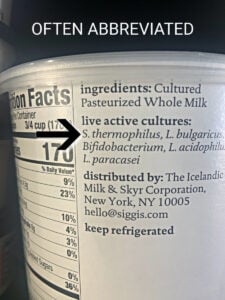 Streptococcus thermophilus is now almost always the first ingredient in yogurt cultures, used in great quantity and dominating the other flora. S. thermophilus wakes up first, grows quickly and creates the right environment for L. bulgaricus, making yogurt making easy and predictable for commercial makers.
Oddly, it’s the law …
The most surprising discovery from my research is that, since 1981, U.S. law has required all products labeled as yogurt to contain both Streptococcus thermophilus and Lactobacillus bulgaricus.
I don’t know how Nancy’s manages to make one yogurt product (and fly under the radar?) without this combination, but I’m so glad they do … (more about this below).
How to make your own yogurt with safe probiotics
The best (easy to find) probiotics to use for homemade yogurt are:
- Lactobacillus Bulgaricus — An ancient strain that’s easy to source.
- Lactobacillus Reuteri — Found naturally in humans, this strain is helpful for restoring gut health and even overcoming H. pylori. To make yogurt with this probiotic, a longer lower temperature very controlled environment is recommended. Oftentimes, a prebiotic is also used with this strain to help ensure success, such as potato starch.
To make an heirloom multi-strain mesophilic yogurt, try this starter with raw milk, or this one.
Which yogurt to buy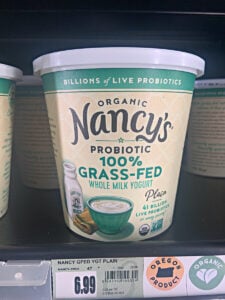

If you want to buy “safe” yogurt, I have only found one brand that doesn’t include Streptococcus thermophilus, and that’s Nancy’s. But not all their products exclude it! Here are their specific products that exclude the undesirable probiotic:
- Organic Nancy’s 100% Grass-fed Whole Milk Plain Yogurt
- Organic Nancy’s Probiotic Kefir
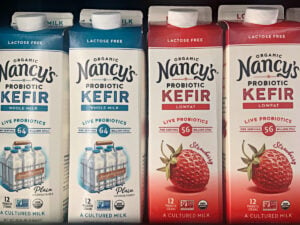 I’ve read the labels on almost every single yogurt at the grocery store, on more than one occasion! In a few cases, I found brands that didn’t contain Streptococcus thermophilus. But every time I found one, it contained added vitamin D instead!
Also avoid yogurt fortified with vitamin D
Remember to also avoid yogurts fortified with vitamin D. I discuss the concerns with supplemental vitamin D in several of my articles; you can read more about it here. (I plan another article on the isolated topic to share more studies and details.)
In short, our bodies are designed to make vitamin D in the skin in response to light.
Vitamin D also plays a powerful role in calcium and mineral regulation. When vitamin D levels become excessively high or mineral balance is disrupted, the body increases calcium release from bone in order to maintain tightly regulated blood calcium levels. Research has specifically found that high vitamin D levels in the blood, as happen with supplementation or fortification of foods, increases bone resorption and decreases bone mineralization.
Vitamin D is also the main and active ingredient in d-CONN (“guaranteed to kill” is their slogan) — the mouse and rat poison.
Pin Why Most Yogurt Turns into Accutane in Your Body here:


Linnie says
Hi Megan,
Thank you for this important, eye-opening article, which I have posted on Grant Genereux’s forum.
I first became aware of the dangers of Streptococcus thermophilus a few months ago, when I bought some oral rehydration capsules that contained four probiotics strains ‘as a bonus’. At the time I knew basically nothing about probiotics and their positive or negative effects on our histamine tolerance. I almost immediately developed insomnia, which lasted for a month. The only factor that had changed in my life were the probiotics, all four of which I learned, increased histamine sensitivity and intolerance. I immediately threw them out but the damage was done and I only began sleeping well again once they’d eventually left my system.
Your article leads me to think that the Streptococcus thermophilus was the main culprit though, because I’ve found in the past that eating high Vitamin A content foods, causes me insomnia. I learned that the hard way too, when I bought into the fad that eating apricot kernel seeds was key to good health. Live and learn!
Megan says
Thanks so much for sharing, Linnie! It’s too bad that we have to learn the hard way, oftentimes. So glad you’re better now!
Heather says
Thank you for this great article! I’ve been wanting to make my own yogurt again. One of the links you gave says the yogurt is drinkable, is the other one for sure regular yogurt? Can I use organic milk instead of raw?
Megan says
Hi Heather, my pleasure. Both of the heirloom multi-strain products are considered yogurt. If they don’t thicken as much as you prefer, you could consider adding agar-agar or similar to thicken more. Yes, you can use regular organic milk; it doesn’t need to be raw. Just be sure to follow any instructions for pasteurized milk, as the process is different.
Josiah says
As far as I know, all or most yogurts can also be strained to thicken them, if desired. That doesn’t mean they’ll all end up a nice, smooth, creamy texture—leave them straining a while and you get yogurt cheese instead! You can also try blending liquid yogurts before straining to get a smoother texture. Note, blending yogurts that already set with a naturally thick curd might break up the curd and ruin the texture, i.e., turn it liquidy.
Cristina B Drake says
Thank you very much for such a helpful article! After hearing Dr Smith talk about this I checked every brand of yogurt at my local health food store and yep, they all contain S. thermophilus! Except for the one you mention above. Currently, my local Grocery Outlet is selling Nancy’s Probiotic Whole Milk Yogurt, and it also doesn’t contain S. thermophilus, so I stocked up.
Megan says
Awesome to hear, Cristina. Thanks for your encouraging words, too!
Marsha says
I have made the L Reuteri yogurt but I just hated the taste of it. I switched over to using the Nancy’s grass fed yogurt as a base and it tastes wonderful. I freeze the yogurt into tablespoon size cubes. I use 2 cubes, 1 tablespoon innulin and cook my yogurt at 100 degrees for 36 hours. I think I’m increasing the probiotic load but i really don’t have a way to test it. Also, what do you think about using A2 1/2 and 1/2 that is not organic vs using Organic 1/2 and 1/2. The organic A2 is unaffordable for me.
Megan says
Thanks for sharing what you’re doing, Marsha. I think it’s more important to use organic dairy than A2, if it’s from the grocery store. I’ve had bad experiences with A2 from the store (vs from a local farm where I know they were fed from grass and soaked or sprouted grains). Every brand of milk is very different as far as what the cows are fed. I find the organic Strauss brand of milk and 1/2 and 1/2 to be the most digestible, personally.
Dorothy says
Oh dear, I’ve been using the Now probiotic-10 50 billion to make oat milk yogurt. I just checked it and it does contain streptococcus Thermophilus )St-21), among the lengthy list of probiotic strains. You used to recommend it, but probably wouldn’t now?
Even worse, I often buy store bought organic yogurt to mix in with the oat milk yogurt, and they probably contain it in large amounts, as well as one brand having added “vitamins”. I don’t think I’ll be getting those again.
I took accutane as a young adult and regret that decision now.
Megan says
Hi Dorothy, I’m sorry that I didn’t know better in the past and led you to buy that. I know exactly where we’d all be if it weren’t for Dr. Smith’s ability to sleuth Pub Med studies and share them with us. It’s okay, though. We can’t change the past. We can only go forward with thankfulness for learning something new and improve for the future. And embrace the joy of the change! 🙂 We truly can celebrate what we know now, and our happy thoughts are medicine, too. A good recognition of disappointment is helpful, but then we just have to move on and live in the present, as that makes us happy, and happy thoughts are healthy thoughts. 🙂
Dorothy says
Thanks Megan, you’re so right. What we think is probably as, or more important than what we eat!
Do you think the probiotic I’ve been using would be minimally adverse to use for a time since that strain is possibly a tenth of the total?
Megan says
I’m not sure how to guess on that. I would perhaps personally be willing to finish a batch of something, but I would not continue making it.
Sarah says
I checked the yogurt we usually buy and it does indeed have Streptococcus thermophilus. : ( What do you think of the heirloom Greek yogurt starter from Cultures for Health? I think we would prefer Greek over the multi-pack in the link because we enjoy thick yogurt. CFH said they do not have a list of specific microbes in their heirloom starters, only in the direct-set starters. Thanks for your help, Megan!
Megan says
Hi Sarah, Happy to help! Streptococcus thermophilus was significantly more common in traditional heirloom starters from warm-weather climates. Because it is a thermophilic (heat-loving) bacterium that thrives at temperatures between 104°F and 113°F (40°C–45°C), it naturally dominated the fermented milk cultures of the Middle East, North Africa, South Asia and Eastern Europe. So if you go with one of CFH’s heirloom starters that are Scandivanian in origin, you should be safe. 🙂 Those cold weather strains include Piima, Viili, Matsoni and Filmjölk. Only Viili is known to be thick, though. Icelandic Skyr is another option. But, in both cases, their thick may not be as thick as you like. The Greek yogurt solution, how it was created, and how it’s made homemade, is actually to strain your yogurt overnight, nested in cheesecloth. The resulting whey can be used in pancake batter, as one option. And you’ll have a nice thick yogurt on top. The other alternative is to use something like agar-agar as a thickener in your process.
Sarah says
Thank you so much, Megan! It’s interesting that you mentioned fermented cultures of the Middle East. I am half Lebanese and love the labne (like a strained yogurt cheese) from our local shop. If Streptococcus thermophilus is a traditional strain for some areas, I wonder… can it be digested better by people from those cultures (maybe it isn’t harmful in the same way)? I guess what I’m wondering is, if heirloom starters have enough microbial diversity, with Streptococcus thermophilus only one strain among many, maybe it is kept in check and not a problem? What do you think?
Megan says
Hi Sarah, your heritage is wonderful, and I also find it sweet to harbor myself at times in the foods from where I originate. I think it’s quite possible that in smaller ratios amidst a native diverse microbial environment the S. therm would be less of a problem.
Dorothy says
Thank you for all your thoughts.
Megan says
Thank you, too, Dorothy; my pleasure. 🙂
Alesha Bruneski says
In Canada, alot of the brands just say “active bacterial cultures” which is so annoying and I can’t check but most of them probably have Streptococcus thermophilus. I think I’m going to try my hand at making yogurt. Have you done videos of doing it ever? I would be a subscriber for sure! 😀 Thanks for all you do for us LYL peeps to help us create beautiful and nourishing food free of toxins. You have been such a blessing to me Megan.
Megan says
So sweet of you, Alesha; I’m so glad. I don’t have the video on YT, but I did a video just for my blog on how to make Oat Yogurt. I’m not sure if you’re avoiding nickel, as oat yogurt isn’t the best choice for that, but that recipe in general is very thorough, so it might be worth taking a look at it. The recipe includes some decent process photos, too, and it’s one my most visited recipes. I hope it helps. 🙂
Josiah says
Do we have an indication of roughly what dose of Accutane one might be getting from yogurt in comparison to a pharmaceutical dose?
Megan says
Good question. At this point, I’d characterize yogurt exposure as unknown and likely far below a pharmaceutical Accutane dose. The more interesting question for us to consider isn’t whether yogurt equals a drug dose, but whether chronic dietary exposure to particular cis-retinoids has biological significance at much lower concentrations. That would require different evidence than the pharmaceutical-dose comparison. Right now, we can only speculate, based on the damage we know vitamin A (oftentimes combined with unknown nickel exposure) does to the gut, that chronic exposure is damaging. Also, knowing that humans have changed the ratios of naturally occurring probiotic bacteria to aid in the packaging process is not reassuring and should be cause for caution.
Josiah says
Yeah, we definitely have enough evidence to merit caution. A quick web search showed that a course of Accutane is pretty long, usually being prescribed to be taken once or twice a day for 15-20 weeks. I would consider that long enough and frequent enough to call chronic exposure, so I wonder if a comparison to yogurt-derived Accutane might actually be easier to make than in some situations.
I also saw some things indicating that it’s prescribed based on cumulative dose over the whole course; some people microdose it, taking a smaller dose for 1-2 years, but “The total cumulative dose is what matters most for acne clearance, not the single-day amount.” This made me wonder if it’s known to accumulate in the body. So, another quick search indicated that, being fat-soluble, it does store in fat tissues, as we would expect from a version of Vitamin A. So, we could guess that Accutane from yogurt, even if the dose is much smaller, will build up over months and years of eating. Also worth noting that the whole reason those people are microdosing is to reduce the known negative side effects of a standard Accutane course, but that doesn’t mean negative effects aren’t there, they’re just more subdued, more subtle, and that’s what we’re being cautious about here.
Megan says
Thanks, Josiah, good points! 🙂