I may receive a commission if you purchase through links in this post. I am not a doctor; please consult your practitioner before changing your supplement or healthcare regimen. As an Amazon Associate I earn from qualifying purchases.
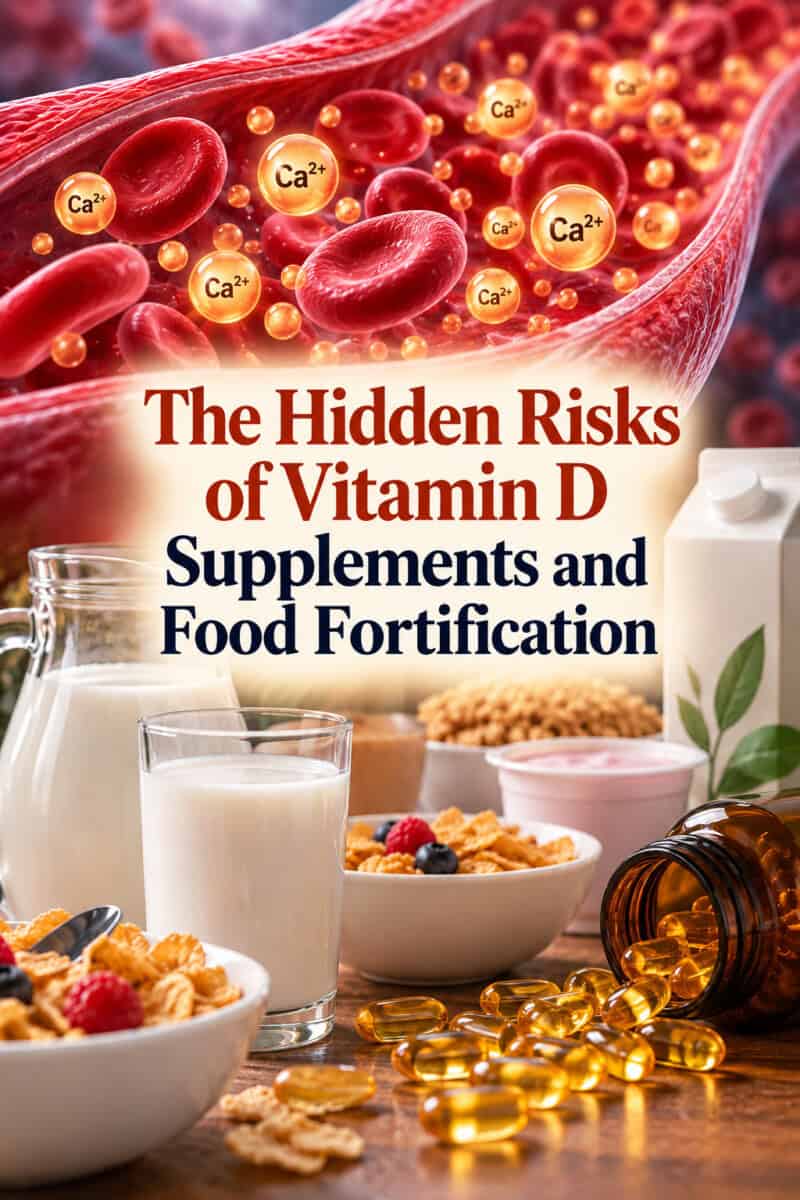
Most Americans are told that vitamin D is essential for strong bones and good health. But what happens when we get too much from supplements and food fortifications? And should vitamin D be routinely added to our food when our bodies are designed to make it from sunlight?
Vitamin D is added to milk, breakfast cereals and many other foods. It’s also included in multivitamins, and millions of Americans take additional vitamin D supplements.
The problem is that vitamin D isn’t just another vitamin. It’s a hormone precursor that affects how our bodies absorb and regulate calcium and other minerals (like magnesium and potassium).
Research shows that excessive oral vitamin D actually disrupts calcium balance, increases the release of calcium from bones and even contributes to bone loss.
Let’s look at what the research found and why we should reconsider taking vitamin D supplements and the practice of routinely adding vitamin D to our food.
1. Vitamin D Is Actually a Hormone Precursor
Our bodies naturally make vitamin D when ultraviolet B (UVB) rays from sunlight reach our skin.
The vitamin D we produce then travels to the liver and kidneys, where it’s converted into its active form, calcitriol. Calcitriol is a hormone that helps regulate calcium absorption, blood calcium levels and bone health.
But too much vitamin D — from supplements and fortified foods — can disrupt these processes.
Excessive vitamin D activity can cause calcium levels in the blood and urine to become abnormally high, potentially damaging the kidneys and other tissues.
The difference between sunlight and supplements
Our skin has a built-in system that limits how much vitamin D we make from sunlight. Oral supplements bypass that particular safeguard.
As we continue to receive UVB exposure, our skin converts excess vitamin D precursors into other compounds, preventing unlimited vitamin D production.
According to the National Institutes of Health (NIH), vitamin D toxicity is caused by excessive oral intake, not sunlight.
2. Higher Vitamin D Doses Actually Caused Greater Bone Loss
In one particularly interesting study, researchers wanted to find out whether taking more vitamin D would improve bone density and strength.
They followed 311 healthy adults for three years. Participants took either 400, 4,000 or 10,000 IU of vitamin D daily.
The results were surprising.
After three years, bone density in the forearm had decreased by:
- 1.2% in those taking 400 IU daily.
- 2.4% in those taking 4,000 IU daily.
- 3.5% in those taking 10,000 IU daily.
Those taking the two higher doses experienced significantly greater bone loss in the forearm than those taking just 400 IU.
The highest-dose group also experienced significantly greater bone loss in the shinbone.
Despite taking considerably more vitamin D, these participants didn’t experience improvements in estimated bone strength.
The study demonstrated that higher doses of vitamin D don’t produce stronger bones: In fact, just the opposite.
3. Too Much Vitamin D Can Pull Calcium From Bones
Another important human study examined six patients suffering from vitamin D intoxication.
Researchers discovered that excessive vitamin D activity increased bone resorption.
Bone resorption is the process through which calcium and other minerals are released from our bones into the bloodstream.
This contributed to the patients’ abnormally high blood calcium levels.
Vitamin D is routinely recommended to support strong bones, yet excessive vitamin D activity can contribute to the loss of calcium from those same bones.
These patients already had vitamin D intoxication. This study doesn’t demonstrate that ordinary supplemental doses cause the same problem.
However, it provides direct human evidence that excessive vitamin D disturbs normal bone metabolism.
4. Long-Term Vitamin D Supplements Can Disrupt Calcium Balance
A much larger analysis examined 48 studies involving nearly 20,000 participants.
Researchers investigated the effects of long-term vitamin D supplementation on calcium regulation.
They found that people taking vitamin D supplements had:
- A 54% higher relative risk of excessive calcium in their blood.
- A 64% higher relative risk of excessive calcium in their urine.
The findings showed that vitamin D supplements interfere with normal calcium regulation.
5. How Much Vitamin D Are We Really Getting?
From the studies and evidence, I don’t believe that any vitamin D supplement or food fortification is safe. But assuming a baseline amount is, we’re still in trouble.
Here’s where supplementation and food fortification become especially concerning.
Almost all conventional American cow’s milk is fortified with approximately 120 IU of vitamin D per cup. Vitamin D is also added to breakfast cereals, plant-based milks, certain yogurts and other processed foods.
Consider someone who drinks two cups of fortified milk daily. They’re already getting approximately 240 IU of added vitamin D. Add a 1,000-IU supplement, and their intake reaches 1,240 IU daily. With a 2,000-IU supplement, it’s 2,240 IU. With a 4,000-IU supplement, they’re consuming 4,240 IU daily from those two sources alone.
This doesn’t include additional fortified foods or naturally occurring vitamin D in their diet.
For most adults, the recommended daily allowance is 600 IU, increasing to 800 IU after age 70.
The adult upper intake limit is 4,000 IU daily — not a recommended dose. A 4,000-IU supplement plus fortified foods can already exceed that limit. And because dietary recommendations assume minimal sun exposure, people who get plenty of sunlight may already produce the vitamin D their bodies need. Why automatically add thousands more IU through supplements and fortified foods?
Remember the three-year study on calcium and bone loss discussed above? Participants taking 4,000 IU daily experienced significantly greater forearm bone-density loss than those taking 400 IU.
Why are we routinely adding vitamin D to foods without knowing how much additional vitamin D each consumer is already taking?
As a young adult, my doctor had me taking 5,000–10,000 IU of vitamin D daily! I loved milk and drank it more than once a day. I also ate commercially made fortified cereals and was in the sun daily. My dose was not decreased during the summer months.
6. Should the Government Be Adding Vitamin D to Our Food?
Vitamin D fortification was originally introduced to help prevent nutritional deficiencies, particularly childhood rickets.
Preventing genuine deficiencies is important. But ya’all, rickets is a meat deficiency.
(This reminds me of forcing vitamin A supplementation on developing countries because we think we know that they have a deficiency. American Hubris. Developing countries lack: clean water, protein (containing zinc and taurine). They do not lack vitamin A. And yet, we increased their mortality rate with our ignorance and zeal.)
People have different amounts of vitamin D already circulating in their bodies. Yet fortified foods deliver additional vitamin D regardless of that fact or the amount of sunlight they’re exposed to — all for a nutrient that doesn’t cure rickets.
The research on high-dose supplementation demonstrates why we shouldn’t assume that more of a nutrient is always beneficial.
It also raises a broader concern about our modern food system.
When we isolate vitamins and routinely add them to foods, we risk increasing people’s intake beyond what they may actually need.
We have good reason to question automatic fortification policies.
7. Our Bodies Are Designed to Make Vitamin D From Sunlight
As mentioned, our skin naturally produces vitamin D when exposed to UVB rays. Unlike oral supplements, sunlight triggers a process that limits excessive vitamin D production.
But sunlight provides benefits that go well beyond vitamin D.
Natural daylight helps regulate our internal clocks, sleep patterns and other important biological processes.
Visible light entering our eyes helps synchronize our circadian rhythms and even helps dental health.
A vitamin D pill can’t replace these benefits (but instead, studies show us it dysregulates the body).
Someone can take vitamin D every day and still miss out on the important health benefits of natural daylight.
This is one reason supplementation shouldn’t automatically be considered a substitute for spending time outdoors.
Of course, sunlight exposure and vitamin D production vary depending on where we live, the season, our age and other factors. Some individuals may need to choose UV light machines as the best alternative (reptile lamp, tanning and Vitamin D lamps, or light therapy) .
8. Do Vitamin D Supplements Actually Prevent Broken Bones?
Another important question is whether routine supplementation delivers the benefits we’re promised.
The U.S. Preventive Services Task Force reviewed research examining whether vitamin D and calcium supplements prevent fractures.
Its 2018 recommendation concluded that taking 400 IU or less of vitamin D together with 1,000 mg or less of calcium did not prevent fractures in generally healthy, community-dwelling postmenopausal women.
Researchers also identified an increased risk of kidney stones associated with combined supplementation.
These findings help demonstrate that routinely taking vitamin D doesn’t provide the bone protection people expect.
9. The Bigger Problem With Isolated Vitamins
Vitamin D is a good example of why we need to reconsider our dependence on isolated nutrients.
Vitamin D plays an essential role in calcium metabolism. Yet excessive supplementation can disrupt that same system. Any single nutrient, if it throws off the body’s balance, will cause depletion in another area.
In the case of Vitamin D, it depletes both magnesium and potassium.
Long-term research shows that higher doses produce greater bone-density losses rather than stronger bones.
While we can trust the benefits of the sun (while avoiding burning), man-made Vitamin D is fraught with problems.
Conclusion: It’s Time to Rethink Vitamin D Fortification
Vitamin D is essential, but oral supplementation carries documented risks.
Human research demonstrates that too much vitamin D can disrupt calcium regulation, increase the release of calcium from bones and contribute to greater bone-density losses at sustained high supplemental doses.
Fortified foods add another source of vitamin D, often without consumers realizing how much they’re getting.
When people combine fortified foods with supplements, their total intake can exceed established upper limits.
Meanwhile, our bodies naturally produce vitamin D through sunlight, which provides additional health benefits that supplements cannot replace.
Rather than automatically adding isolated vitamins to our food, we should be asking whether people actually need them, how much they’re already consuming and whether the benefits outweigh the risks.
We should also ere on the side of receiving nutritional naturally, in this case through light exposure.
Pin this article here:

Leave a Reply