I may receive a commission if you purchase through links in this post. I am not a doctor; please consult your practitioner before changing your supplement or healthcare regimen. As an Amazon Associate I earn from qualifying purchases.
Borosilicate Glass Cookware: The Best Pot You’re Not Using Yet shares with you why I love my newest pot, and why most health conscious consumers should start adding borosilicate glass to their kitchen.
Borosilicate glass is considered safer than other cooking materials due to its high resistance to thermal shock, chemical inertness and non-porous nature. This means it can withstand extreme temperature changes without shattering, won’t leach harmful chemicals into food and is easy to clean, reducing the risk of bacterial contamination.
Many of us look at all the pots and pans on the market — and try to decide which material is the least toxic.
What’s the safest material to cook on or in?
When I received an email recently asking me about which pots and pans I use, I sent the reader information about my favorite cookware (non-toxic, nickel-free). But afterwards, I realized how important my newest glass pot has become to me — and that it was time to share borosilicate glass cookware with more people.
Most of us don’t realize: There’s a new world of safe pots for us to use.
Borosilicate glass cookware is a safe option for pots and baking pans — for anyone looking for low risk cooking and baking supplies.
Not only is borosilicate glass cookware safe, it is also VERY affordable (cheap!).
In this article, we look at:
- What is borosilicate glass
- Why is borosilicate glass safer than other cooking materials
- What cookware is available made from borosilicate glass
- What’s a good alternative to borosilicate glass
What is borosilicate glass
Borosilicate glass is composed of silica and boron trioxide as the main glass-forming constituents, along with other components 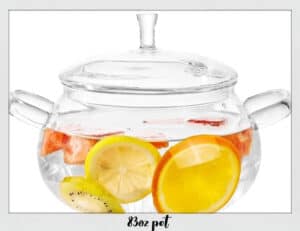 like alumina and soda or potash. This composition gives it some superior properties compared to soda-lime glass (which has its own benefits — and I’ll discuss those more below), such as greater resistance to heat, chemicals and scratching.
However, not all borosilicate glass products are made to the same quality standards. When you go to purchase, be sure to choose a product with good customer reviews for durability (and more that I’ll share below, with specific links to products).
WHY? — Borosilicate Glass Cookware: The Best Pot You’re Not Using Yet
Borosilicate glass has a low coefficient of thermal expansion, meaning it expands and contracts very little when exposed to temperature changes. This makes it incredibly resistant to cracking or shattering when subjected to sudden temperature fluctuations, such as going from a hot oven to a cold countertop or vice versa.
Why is borosilicate glass safer than other cooking materials
 Unlike some plastics or metals, borosilicate glass does not react with most acids, bases or other chemicals. This means it won’t leach harmful substances into your food, even when exposed to acidic or alkaline ingredients like tomato sauce or citrus fruits.
What cookware is available made from borosilicate glass

When you go to buy, choose borosilicate glass cookware specifically labeled as lead-free and BPA-free. Sadly, not all labeling is accurate. If a product is designed in Europe, or made somewhere other than China, it is more reliable.
Here are some cooking pots we like:
Here’s the teapot I’ve owned and loved for years:
- 12 cup Whistling Tea Kettle (German made)
More tea pots
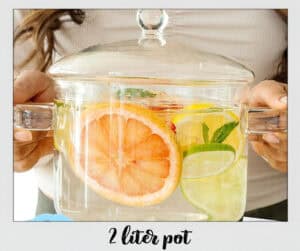
- All Glass Tea Pot for stove top (European design, noted: lead-free)
Is Pyrex borosilicate glass
Yes, Pyrex is a brand name for borosilicate glass. And that leads me to final recommendations for oven use.
This amazing baking dish even has a borosilicate glass lid, and reviewers love it:
- Pyrex Deep 5.2-Qt (9″x13″) 2-in-1 Glass Baking Dish with Glass Lid (better and safer than ceramic)
More borosilicate glass baking dishes and storage containers with lids can also be found here.
Conclusion
Honestly, I look forward to more manufacturers of sturdy borosilicate glass cookware. We need manufacturers in Europe, the US, or other reputable countries who provide lead-free certifications and non-fragile products.
I’ll continue to use a combination of nickel-free stainless steel and borosilicate glass for cooking.
For those of you who need a great stainless steel pan set that won’t leach nickel, this one can’t be beat for safety.
Other safe glass and items: Soda-lime glass
In learning about borosilicate glass, I also learned about soda-lime glass.
At first glance: Borosilicate glass is more likely to be lead and cadmium-free than soda-lime glass. While both types of glass can be manufactured to be lead and cadmium-free, borosilicate glass is inherently less likely to leach these substances due to its chemical composition.
And yet, while that’s true in most cases, what about when you …. Come across a company in France that makes the highest quality lead-free and cadmium free soda-lime glass that’s also really durable?!
Duralex
I found a company out of France whose products are all lead-free, cadmium-free, and they’re strong (very unlikely to break).
While I love borosilicate glass, its weaknesses include that many products are still made in China, don’t have reliable lead-free testing, and some of them are still fragile.
I have seen third party testing of multiple Duralex products come back lead free, and their company complies with the highest standards, set in California, for food-safe materials. The company says of its products, “Duralex glass is very hygienic: it is non-porous and does not absorb liquids, colors or flavors; Lead free, cadmium free, and BPA free“.
Unfortunately, Duralex does not make cooking pots for the stove top. But their dishes are 2.5 times more resistant to breakage and chipping than normal glass and worth owning. The reviews on these products from buyers are excellent, with a growing base of faithful and loyal customers due to satisfaction. Here are some well-loved items:
- Blue Tumblers (drinking glasses)
- Small Glasses for juice, espresso, alcohol etc.
- Glass Mugs
- 6 Parisian Bowls
- Ramekins for Oven or Microwave (tons of uses)
While some soda-lime glass is more sensitive to hot and cold temperature changes, this is not the case with Duralex, which states, “Can also withstand sudden thermal shock, from -4 F to 212 F”.
Now we can just hope Duralex will start making pots!
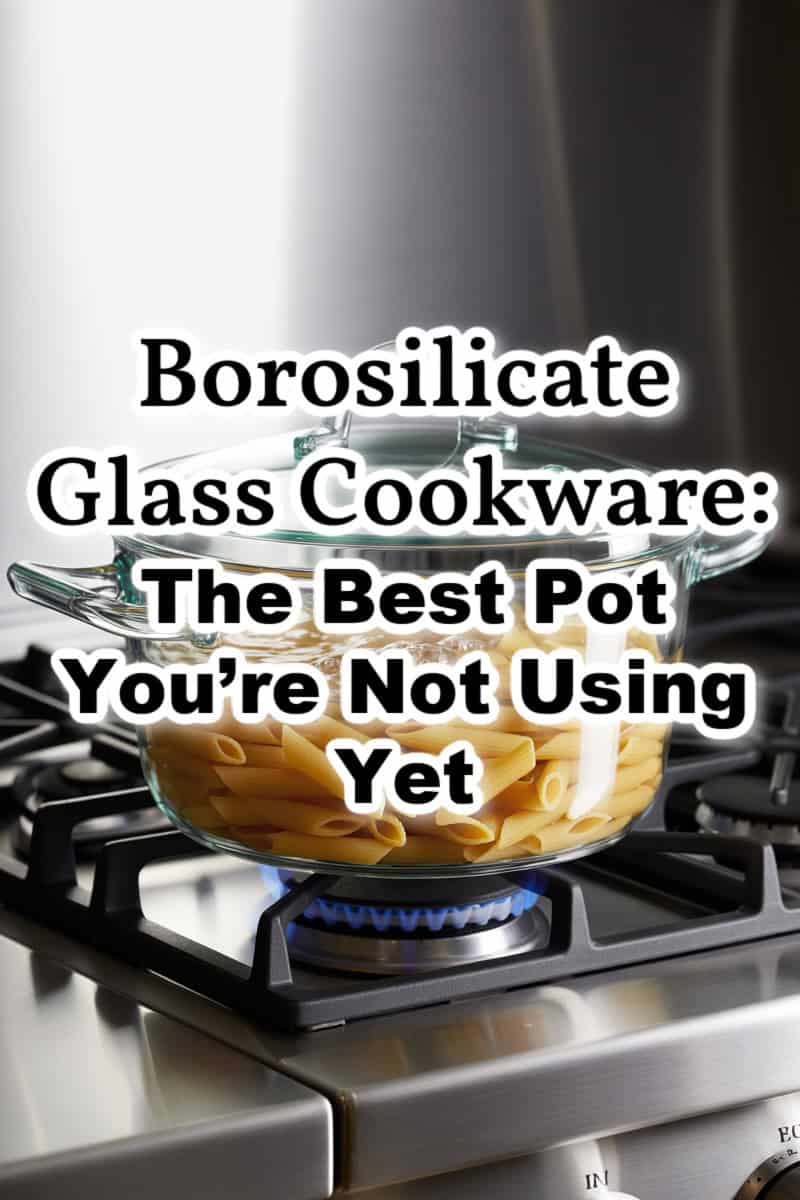
Pin Borosilicate Glass Cookware: The Best Pot You’re Not Using Yet here:

Doreen says
Hi! Do you think a Duralex tempered glass bowl would be healthy for my dog to eat and drink out of?
I heard borsilitate would be the safest, but can’t find. :(. Thanks for any help you can give me.
Doreen
Megan says
Hi Doreen. From what I’ve read, Duralex tempered glass is safe and a good option. 🙂
Nanci Tipton says
Can you comment on the older brown glass cookware? It also came in cranberry and I think it was pyrex. I still have a nice casserole dish I use and a pan with handle but I never got used to it and it had issues with sticking. (THis was from the 80’s I think!) D:”
Megan says
Hi Nanci, Vintage solid brown or cranberry glass from the 1980s likely contains some lead, but it is generally safer than painted or crystal items if not used daily. While cranberry glass often uses gold or copper, brown glass might use metal oxides. The highest risk is if these items are used to store, or consume, acidic liquids (like wine or orange juice) frequently. So display only, or infrequent use are recommended.
Nanci Tipton says
Thank you so much for the helpful information!
Megan says
You’re welcome; my pleasure!
Jana says
Oh no! I just found an old Visions light brown skillet (like this: https://www.etsy.com/listing/1770745759/10-pyrex-visions-amber-glass-skillet ) at my local thrift store, and was so excited since it was non-metal and figured it would be all right. So I bought it. And /then/ I checked your blog :p
I’ve been scouring the Internet for other sources about it…. I read about the drawbacks of Tamara’s XRF testing as well, but she did write in 2018 that there was no lead, cadmium, mercury etc. detected in a sample. I think she mentioned a wide range between samples. The company itself, and affiliates, of course say that they don’t leach anything since they’re non-porous. Of course I worry about nickel now too, and copper and such. Mine is also likely old and from a couple decades back… don’t know if that’s good or bad now….
Now I’m all kerfuffled. D: I should have just got the Homichef :p
Megan says
Hi Jana, I’m sorry! Well, you could use it occasionally and for non-acidic foods … And then yes, Homichef or B. glass if you want to budget for one of them. Hugs!